

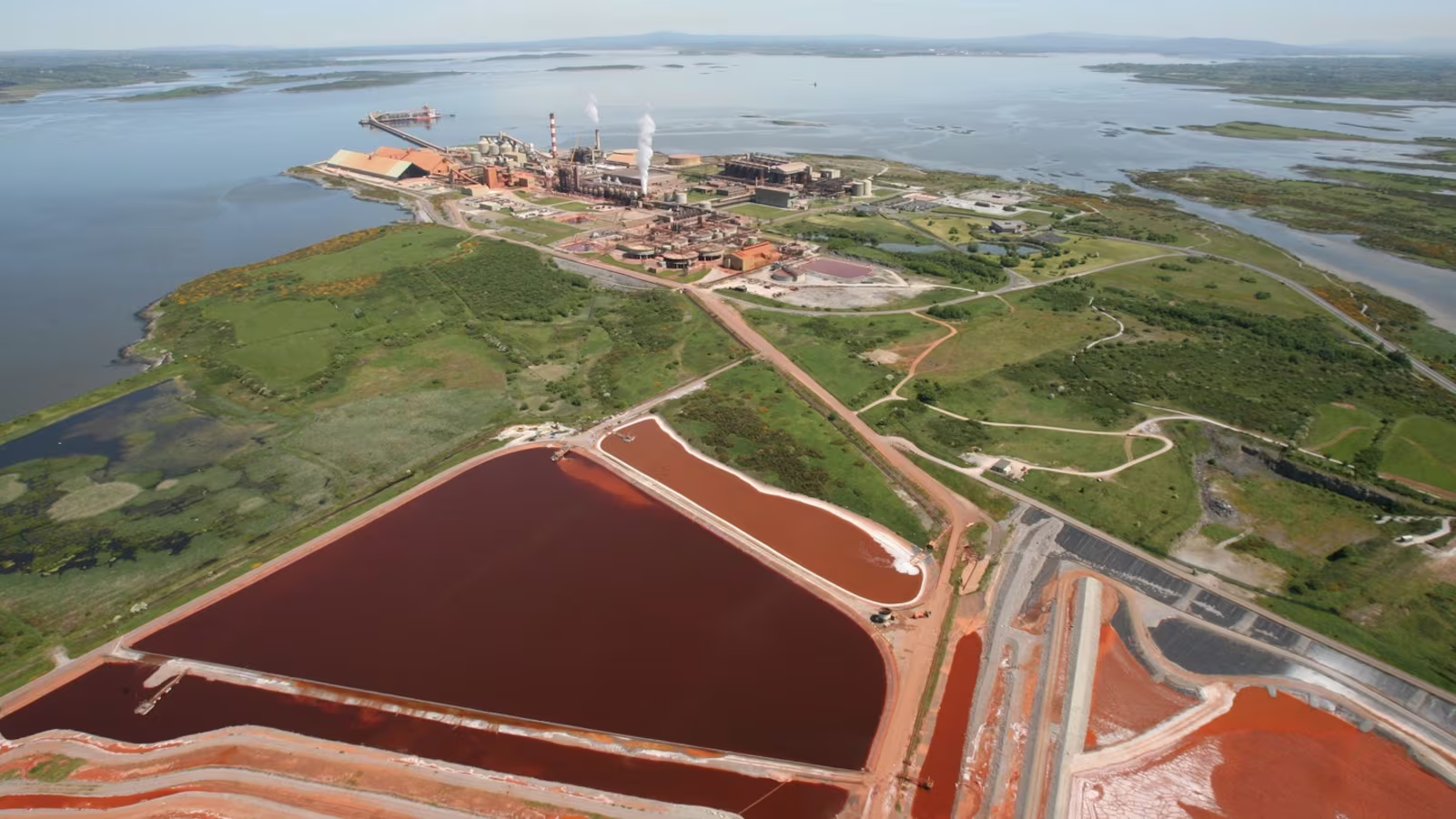
Alumina produced at Ireland’s Aughinish Alumina refinery, owned by the Russian aluminum giant Rusal, continues to be exported to Russia despite the full-scale invasion of Ukraine, according to an investigation by OCCRP and its partners. It is later processed into aluminum at Russian smelters and subsequently sold through intermediary traders, which supplied aluminum to dozens of Russian defense-sector companies sanctioned by the EU and other jurisdictions.
Yet the controversy surrounding Aughinish extends beyond the refinery itself. Even if Irish authorities were to investigate the ultimate destination of their exports, there is no practical mechanism to guarantee oversight once alumina enters Russia’s domestic industrial ecosystem. As a result, the case raises broader questions about the limits of sanctions policy, corporate ownership, and the regulation of strategic commodities whose civilian and military applications are often impossible to separate.
Following the publication of the investigation, NAKO submitted a series of inquiries to the Irish authorities seeking clarification regarding the government’s assessment of alumina exports to Russia, the oversight mechanisms applied to such exports, and any actions taken to address the risk that Irish-origin alumina may enter industrial supply chains supporting Russia’s defense sector.
While awaiting official responses, it is worth examining the broader context surrounding the case, including the economic significance of the refinery, the role of its ownership structure, and the reasons why alumina exports to Russia have remained outside the scope of European sanctions.
Three questions emerge from this discussion. Why do sanctions against Oleg Deripaska not automatically extend to his industrial assets? Why do alumina exports to Russia remain legal despite concerns about downstream military use? And finally, is meaningful oversight of these supply chains possible at all once the material crosses the Russian border?
Irish Aughinish Alumina is Europe’s largest alumina refinery, turning raw bauxite from Brazil and Guinea into alumina for export. While concerns over the final destination of this alumina have been a major concern for journalists and investigators, the Irish government – including the prime minister himself – has repeatedly claimed the plant plays no part in supplying materials to Russia’s military-industrial complex. The company itself had previously stated that only 45% of its output was destined for Russia.
Official statistics and trade data show that Russia has been a significant destination for Irish alumina exports before the full-scale invasion of Ukraine and remained so afterward.
Historically, Russia was and still is the largest consumer of the said alumina – its share fluctuates between 37% and 47% of Aughish’s revenue, according to customs data reviewed by NAKO. For instance, between 2022 and early 2026, Russia accounted for almost 44% of the supply (roughly a billion), which is almost the same as all the EU member states combined (primarily France and Sweden).
Eurostat shows a slightly different picture: between 2018 and 2021, Ireland exported an average of 386 thousand tonnes annually to Russia, compared to 679 thousand tonnes to the EU. Following 2022, exports increased substantially to both destinations. However, exports to Russia grew more rapidly, reaching an average of 715 thousand tonnes per year (representing an increase of approximately 144% in value and 85% in volume). In comparison, exports to the EU averaged 909 thousand tonnes – mostly due to a dramatic increase in 2024-2025. Overall, Ireland supplied Russia over a billion worth of alumina, while EU figures exceed €1,3 billion.
Both sources suggest that while Russia’s share of Irish alumina exports appears to have increased relative to the pre-war period, it remains comparable in scale to exports destined for the entire EU market.
The majority of these exports were directed to Rusal’s major aluminum smelters, including nearly €500 million worth of alumina shipped to the Sayanogorsk Aluminum Plant and more than €600 million to the Krasnoyarsk Aluminum Plant. Together, these facilities constitute a significant share of Russia’s aluminum production capacity and play an important role in supplying the downstream industrial and manufacturing sectors. They also, together with Aughinish Alumina and its Brazilian and Guinean mines, lead to Oleg Deripaska, a sanctioned Russian oligarch.
While having close ties to the Kremlin, Deripaska’s influence stems primarily from building a vast aluminum and metals empire without holding any government position. Rusal, previously known as the world’s second-largest aluminum company, is one of Deripaska’s key assets.
In 2018, the U.S. sanctioned Deripaska, as well as Rusal and EN+ Group, its shareholder. The sanctions caused a major disruption in global aluminum markets and prompted restructuring within these companies (reducing Deripaska’s shareholding and introducing management changes) to lift the sanctions against the companies, but not against Deripaska himself. Following the full-scale invasion of Ukraine, Deripaska was also sanctioned by the EU. His assets – Rusal and EN+ Group – were not.
Currently, the ownership structure looks as follows: Auighinish Alumina is fully owned by Rusal; over 56% of Rusal’s shares are owned by EN+ Group, while 44,9% of EN+ remains Deripaska’s. This enables sanctioning Deripaska individually without affecting the companies he technically still owns and controls.
Apart from general industrial production, aluminum is a critical input for aerospace manufacturing, missiles, military vehicles, and naval construction. While there is no direct evidence that could unequivocally confirm Rusal’s aluminum is used in any of such military goods produced for the Russian military, the very role of Rusal in both the global market and the Russian one in particular makes it hard to ignore potential links between locally produced aluminum and its further usage for military production.
Moreover, according to OCCRP, Krasnoyarsk and Sayanogors plants have sold more than $650 million worth of the metal to a Moscow-based trader, Aluminum Sales Company (ASK) – yet another company connected to Rusal. Citing the leaked transaction data, the journalists found that ASK customers include multiple Russian entities involved in weapons production.
The case of Aughinish Alumina demonstrates yet another extremely complicated and important example of global commodity markets meeting geopolitical developments and the complexity of international ownership structures in an economically significant but fragile region.
In response to the investigation and Rusal’s business with weapons manufacturers, a few questions emerged.
Firstly, why do individual Deripaska sanctions not automatically touch his assets – Aughinish, Rusal, EN+ Group?
The 2018 sanctions on Rusal and EN+ Group by the U.S. and their subsequent lifting following a major market response partly answer the first question. Rusal’s ownership and management restructuring provides a legal basis for avoiding the automatic broadening of Deripaska’s individual sanctions to all of his assets.
Sanctioning Aughinish Alumina is also a challenging topic. While the statistics vary by source, it is evident that Russia’s importance as a customer is broadly comparable to that of the entire EU market combined. While some of the data demonstrates quite a dramatic change in the EU figure in the latest years, the refinery is as important to the EU as it is to Russia.
And this is where the second question arises: Why are exports of alumina (the raw material used to produce aluminum) from Europe to Russia unsanctioned, while aluminum itself is strictly prohibited for export?
While important for the EU and Russia, it is also important to Ireland. Aughinish was established in the 1970s by the Canadian company Alcan in response to the aluminum boom. Strategically located in a place with deep-water access, land availability, and the needed energy and transport infrastructure, the refinery became one of the largest industrial projects in western Ireland, eventually making it the largest alumina refinery in Europe, not only promoting the region’s industrial development but also integrating it into global commodity networks.
The fertilizer debate, covered in NAKO’s recent analysis, illustrates a somewhat similar policy challenge: primarily civilian commodities can nevertheless contribute indirectly to Russia’s war economy. Typically considered civilian due to their association with agriculture and food security, fertilizers still fall under the dual-use category, as some can be used to manufacture explosives for the Russian military. Unlike alumina and aluminum, Russia is fully self-sufficient across the entire spectrum of the fertilizer industry. That adds billions in annual revenue, directly supporting its war machine through exports.
It thus makes any serious ban on Russian fertilizers a politically sensitive best-case scenario and a serious threat to global food security in the worst-case scenario. Western and Western-aligned states – even if aiming to invest less in the Russian war economy by buying fewer of its agricultural goods – need to go through a full cycle of multi-layered consideration to craft a new strategic policy.
Akin to fertilizers for agriculture, alumina is a strategic industrial input used throughout European aluminum supply chains, and restrictions on it would have consequences extending far beyond Russia. Therefore, any reactive, restrictive measures against the refinery itself or Russia’s alumina exports (especially given almost equal market shares) risk economic fragility and social and political turbulence. A less reactive response requires thought and consideration of specific economic policies, market restructuring, and regional development to ensure the local economy’s survival during the transition period. This is the reason Aughinish and alumina exports have been mostly “invisible” to both Ireland and the EU for the last four years. The current crisis has made the topic hard to ignore, yet the discussion still mostly leans toward reactive approaches.
Now the third main question is: what is next?
While the Irish government investigates whether the supply chain of its alumina eventually includes military end-users, the real question is whether there are any ways to guarantee that this material can actually be subject to oversight and control once it crosses the Russian border. The answer is, of course, no.
Unlike typical sanction evasion schemes, this one is deeply intertwined with the Russian business community. Aughinish claims to have robust due diligence and to operate “in strict compliance with all applicable European Union laws, including sanctions, export control measures and trade regulations.” Yet its eventual ties to the Kremlin-linked oligarch and its business empire throw doubt over any sanctions compliance discourse by default.
Given Aughinish Alumina’s importance as both a major regional employer and a strategic European industrial asset, policymakers should explore alternatives that would allow the facility to remain operational while reducing or eliminating dependence on the Russian market.
Potential options include state intervention, including partial or full nationalisation if necessary to preserve production and employment, as well as a structured search for alternative export destinations. In particular, the United States warrants further examination as a potential market, given its industrial demand for alumina and broader efforts to secure resilient supply chains for critical materials.
The key policy question is not whether the plant should continue operating, but whether sufficient efforts have been made to identify viable alternatives to exports linked to Russia. A comprehensive assessment of alternative markets, ownership structures, and transition mechanisms should therefore be a prerequisite for any future policy decisions.
Ultimately, the Aughinish case illustrates a broader challenge facing Western sanctions policy. Strategic commodities rarely move through simple supply chains, and economically significant industrial assets often become embedded in ownership structures that transcend national borders. As long as alumina remains unsanctioned and Russia remains a major destination for Irish exports, questions about downstream military use are likely to persist. Whether policymakers choose to address those concerns through sanctions, market restructuring, or enhanced oversight will ultimately depend on balancing geopolitical objectives against economic realities.
Photo: Liam Burke / Press 22