

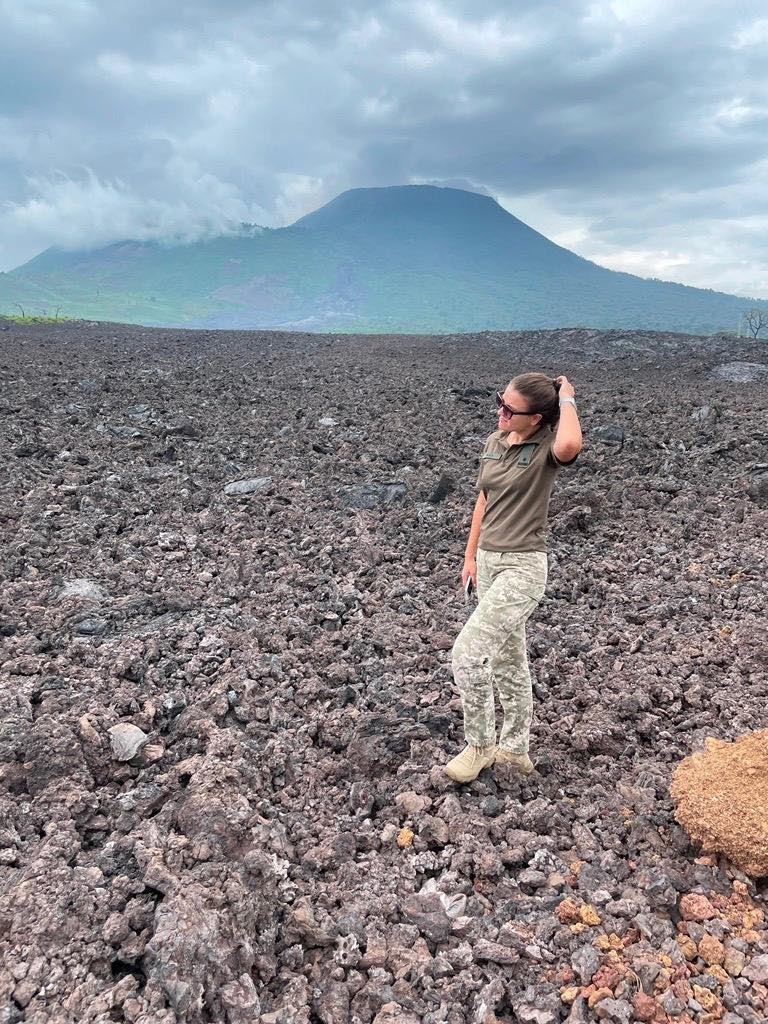
Since 1992, Ukraine has been taking part in UN peacekeeping missions. This includes contributing national personnel, military observers, and national troops, e.g., the 18th separate helicopter detachment of the Ukrainian Armed Forces in the Democratic Republic of Congo. However, during the whole history of the Armed Forces of Ukraine, only two women have ever joined the UN military contingent. A few more were engaged as military observers or staff officers.
Why is the number of Ukrainian women participating in peacekeeping missions so small? How hard is the selection process? Is it more difficult to build a career in the military if you are a woman? We had an opportunity to discuss these questions with Major Iryna Zavorotko, a Ukrainian female peacekeeper and a part of the Ukrainian national personnel in MONUSCO, the United Nations Organization Stabilization Mission in the Democratic Republic of the Congo.
Since 2016, she has been serving in the General Staff of the Armed Forces of Ukraine. In 2016, she participated in the Joint Forces Operation in the Donbas. In 2018, she successfully completed a NATO Gender Adviser course in Sweden. Since January 2021, she has been a staff officer at MONUSCO as part of the Ukrainian national personnel. She participated in evacuating the local population following the eruption of the Nyiragongo volcano near the city of Goma in the Congo.
This material was created as a part of the Eastern Flank program, a joint project by Censor.NET and the Independent Anti-Corruption Commission (NAKO).
– It takes some time between the moment you realize you want to go or even take a UN Military Observer course and the moment of your actual deployment. In my case, it was around 18 months. This is considered rather quick and effective. I wouldn’t say that today the number of women is minimum or small, as there were three women among 11 members of the national personnel when I joined the mission in the Congo. It is a very high percentage and it has never happened before in the history of our national personnel in MONUSCO. I would say that more crucial is the question of women’s participation in national contingents. The previous rotation of the 18th separate helicopter detachment was the first time since Ukraine had participated in the mission in the Congo that a woman was part of the personnel.
Historically, looking at the progress made by the Armed Forces of Ukraine as an independent country and the Armed Forces of Canada or the U.S., the timeframe is absolutely different. Therefore, Ukraine has made incredible progress over the last seven years since the Russian aggression of 2014. The progress Ukraine has achieved so far wasn’t imposed by international organizations or partners but was driven by Ukrainian society from within. It was a real necessity to defend the country, regardless of who you are, a man or a woman. Everyone was struggling to defend our independence. Therefore, I think we achieved such great results because gender policy implementation started internally.
Regarding the excuses that I cannot be a part of the national personnel due to my gender. First, I don’t have any kids, so maybe that’s why I have never heard anything like that. Instead, back in 2015, I used to hear that I cannot be sent to the Anti-Terrorist Operation zone. I was a recent graduate and I had just joined the brigade when I said that I would like to participate in the operation. So I was told things like, “Go get your parents’ consent before we can even consider your request.” It came not from the commander though, but from other brigade officers. Obviously, I never approached my parents for any such thing and they learned about my deployment to the ATO zone only upon my return.
Therefore, whenever I’m asked about the way to increase the percentage of female members in the national personnel and contingent, I say that first of all, it’s about sharing personal experience by those who participated in the mission. It has a huge positive impact on your willingness and readiness, changing your perception completely.
– So de jure it is a restriction but in fact, it has no real impact on women’s chances to be appointed. In the case of peacekeeping missions, lifting the restrictions for women did matter and I will explain why. Imagine a national contingent, e.g., the 18th separate helicopter detachment participating in MONUSCO. For a female service member to get on the national contingent, she must qualify for a relevant position in her national system. If you are a signalist, you can only join a national contingent as a signalist. If you are a lawyer, you can only go as a lawyer. If the position is restricted in Ukraine, e.g., a woman cannot be a navigator, then obviously she has no chance to join a national contingent in this specific capacity. It was the only legal restriction affecting women’s participation in national contingents.
There are no special dress code rules here in MONUSCO. This is because it’s a multi-national society comprising members of the armed forces of many countries. Each country has its own rules of conduct, including rules governing their dress code. That said, I have never met a woman in a uniform wearing a sparkling manicure here at the UN base. In other words, we wear no makeup or manicure when in the military uniform and at the base. However, it does take place if a country is hosting a National Day or there is a celebration. As they often say, the female element does not go anywhere, but there is the right place and the right time for it.
On promoting the visibility of women, I think it would be enough to share success stories. Imagine a woman is sitting at home or at work. She sees an interview with another woman and gets inspired by her example. So she can think to herself, “Look, I am good at this, this, and this; I’ve achieved this, and I am the best at that, so maybe I am not any worse and I should tell you about myself and maybe my case will inspire others.” I think this is the key to promoting visibility. The more examples like this we see, the more people are willing to share their own experience to inspire others.
There are around 32,000 servicewomen in the Armed Forces of Ukraine. It is one of the highest ratios between male and female military members in the world. But we have only one female general, one woman who can become a service member of the Special Operations Forces, and two female peacekeepers serving in the military contingent.
By signing the UN Security Council Resolution “Women, Peace and Security”, Ukraine has committed to increasing the role of women in the peace process and intensifying their engagement in peacekeeping operations. Numerous UN studies demonstrate that the more women are engaged in a mission’s decision-making, the more effective the mission is in ensuring sustainable peace.
Source: https://censor.net/ua/v3304471