

Press release.
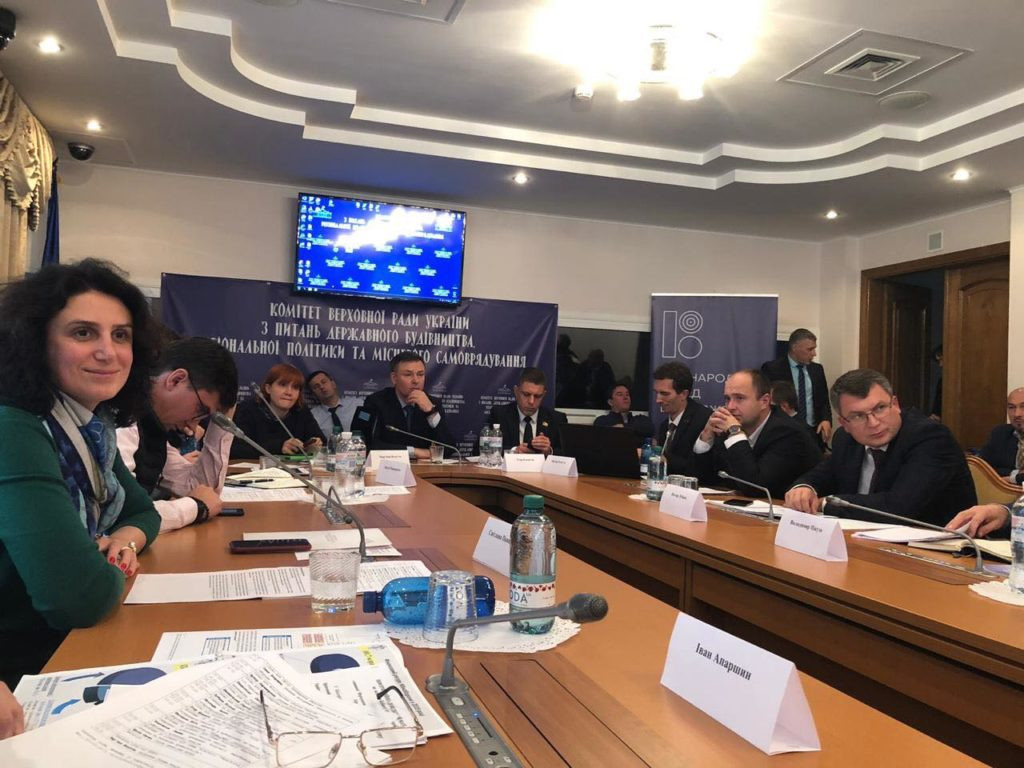
On October 9, 2019, reforming the defence procurement system was discussed at the roundtable organized by the Verkhovna Rada Committee on national security, defence and intelligence, NAKO and the independent analytical center Ukrainian Institute for the Future. Namely, the debate was about the draft law which was later introduced to the Parliament as the one which is supposed to replace the existing Law on State Defence Order. For the first time ever the representatives of the key stakeholders including state institutions, state and private arms producers and the civil society joined the discussion. In particular, the participants included MPs, the representatives of the Ministry of Economy, Trade and Agriculture, the President’s office, the Security Service of Ukraine, the state defence enterprise Ukroboronprom, the League of Defence Enterprises of Ukraine, the Assosiation of Producers of Arms and Military Equipment of Ukraine, the Association ‘Ukrainian Defence and Security Manufacturing’.
The event was opened by Head of Parliamentary Committee on National Security, Defence and Intelligence Olexander Zavitnevych. The roundtable was moderated by Deputy Minister of Economy, Trade and Agriculture Svitlana Panaiotidi. Every participant had an opportunity to express his view on important aspects which should be taken into consideration in the new legislation on state defence order. ‘We are open to public discussions, to engaging the civil society and to formulating the new legislation together,’ said Deputy Head of the Parliamentary Committee Mariana Bezuhla.
NAKO Secretary General Olena Tregub presented the results of NAKOs brief, ‘Reforming the State Defence Order System’, namely she spoke on the existing corruption risks and ways to minimize them. The state defence order budget increases every year but the system remains inefficient and prone to corruption, this is why it should be reformed as soon as possible, – said Tregub. She stressed that the civil society hopes to see in the new legislation the increased level of transparency and competitiveness, pricing closer to the market mechanisms and enhancement of SDO approval and control, in particular, automatization and digitalization of the process.
‘Those problems that we discussed 20 years ago are still on the table now. Nothing has changed’, said Ivan Aparshyn who represented the President’s Office. He mentioned that it was the right time to pass from words to deeds and added that the President’s office is actively involved into discussion of the draft law on public procurement and is ready to cooperate with the other state bodies and representatives of the civil society.
Advisor to Minister of Defence Artur Pereverzev presented the progress as for the new draft law on defence procurement. He mentioned that overclassification negatively impacts such procurements. That’s why the new draft law stipulates two types of procurement: classified and public ones which take place through Prozorro. However, Pereverzev said that the new legislation in defence procurement only is not enough. In his opinion, it is necessary to replace the law on State Secret: ‘It is necessary to find the balance which will allow this law to work and this will not cause the leak of really valuable information which has to be classified’.
Advisor to Director General of Ukroboronprom Mustafa Nayem mentioned that elimination from the draft law of the so-called estimate-calculation material (РКМ in Russian) is a positive change. But he added that the document needs serious follow-up revision from the point of view of the number of risks, in particular when it comes to the mechanism of control of the quality of production. He said that it was necessary to define the co-contractors and sub-contractors of contracts and to clarify the scope of their work as such lack of clarification creates considerable risks and can lead to concluding fictitious contracts.
Head of the Assosiation of Producers of Arms and Military Equipment Vadim Kodachigov shared his personal experience of cooperation with the state in the area of defence procurement. According to him, no arms producer is currently using its capacities at the level of 50%: ‘Currently we are producing arms for 700 mln dollars where 500 mln goes for export and 200-250 to internal customers. Due to our estimate, we can produce arms for 3 bln dollars. Companies are not fully occuied’. Also the participants discussed the key aspects of management at state enterprises, the problem of secrecy classification in procurement as well as the need to create the central executive body that will deal with defence manufacturing and centralized procurement at the Ministry of Defence. Search for balance between protecting the local producer and development of our own defence industry and opening the market to foreign arms producers has become one of the hottest discussion topics.
As a result of the discussion the further ways for cooperation between the state bodies, private enterprises and civil society representatives have been defined, with the aim to finalize the concept of the draft law on defence procurement and reform the system of military and industrial complex in general.