
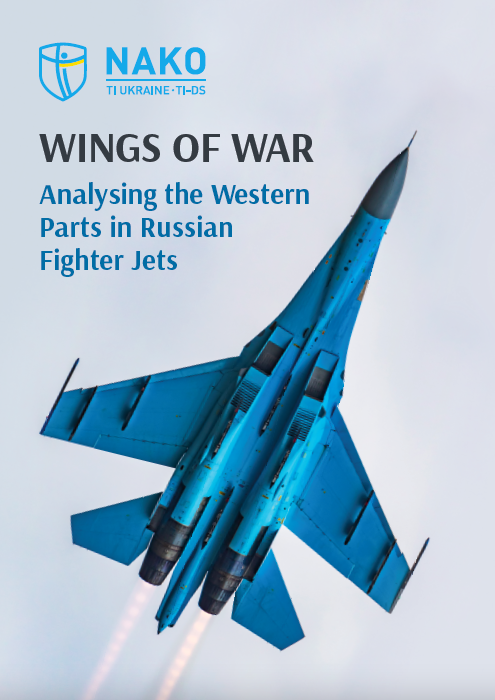
The Russian Federation Aerospace Forces have been the central part of Russia’s full-scale invasion of Ukraine since the first days. As the full-scale war began, Russian Su-34 bombers, Su-30SM fighters, and Su-35S fighters reportedly flew around 140 sorties in the first few days and struck targets all over Ukraine.
Within the first couple months of the full-scale invasion, Russia had fired more missiles against Ukraine than any country had employed in a war since World War II.Russia maintains an undoubted advantage in aviation despite significant losses. As of the end of February 2024, the estimated losses count over 345 aircraft and 325 helicopters. Yet even despite the losses and sanctions, Russia continues expanding its production capabilities.
NAKO analysed over 2,000 components found in the six aircraft pieces used by the Russian Air Forces: MiG-31I, Su-27SM3, Su-30SM, Su-34, Su-35S, and Su-57. We also identified via open-source information the central plants and several pieces of equipment used to produce these jets.The Air Forces of Ukraine require 40-50 F-16 aircraft for its short-term needs, while a long-term perspective makes five aviation brigades: 180 aircraft. The cost estimates, therefore, vary from over $1 billion to $10 billion.
At the same time, in 2023, Russia spent at least $4 billion purchasing electronics for various military purposes, including maintaining and producing its fighter jets.We highlight over 200 companies around the world that are or can be of potential interest to the Russian Federation and its military-industrial complex. Therefore, we strongly recommend the manufacturers, mentioned in this report ensure they are compliant while exporting to counties outside the Global Export Controls coalition and/or intermediaries in the risky jurisdictions. For more information on enhanced due diligence and advanced know-your-customer policies, we recommend consulting with the guide NAKO co-authored in partnership with The Royal United Services Institute (RUSI), The Open Society Justice Initiative (OSJI), and the Heartland Initiative.
This report is another part of NAKO’s efforts to weaken Russia’s capability to wage war against Ukraine, preventing its military-industrial complex from gaining essential Western technologies, and ensuring Russia is held accountable for its war crimes.
This report was compiled with the support of the International Renaissance Foundation. Its content is the exclusive responsibility of NAKO and does not necessarily reflect the views of the International Renaissance Foundation.
