


Closing loopholes in Western sanctions and increasing pressure on Russia were the focus of a discussion held on July 8 at the Kyiv School of Economics (KSE), bringing together Ukrainian civil society organizations, researchers, government representatives, and the EU Sanctions Envoy, David O’Sullivan.
The Independent Anti-Corruption Commission (NAKO) took part in the discussion, raising critical issues related to export controls, sanctions compliance, and the enforcement of sanctions violations.
During the roundtable, “Identifying the Most Effective Sanctions Targets and Enforcement Priorities,” EU Sanctions Envoy David O’Sullivan outlined Brussels’ three key priorities: restricting Russia’s access to foreign components, disrupting financial channels, and reducing the Kremlin’s energy revenues.
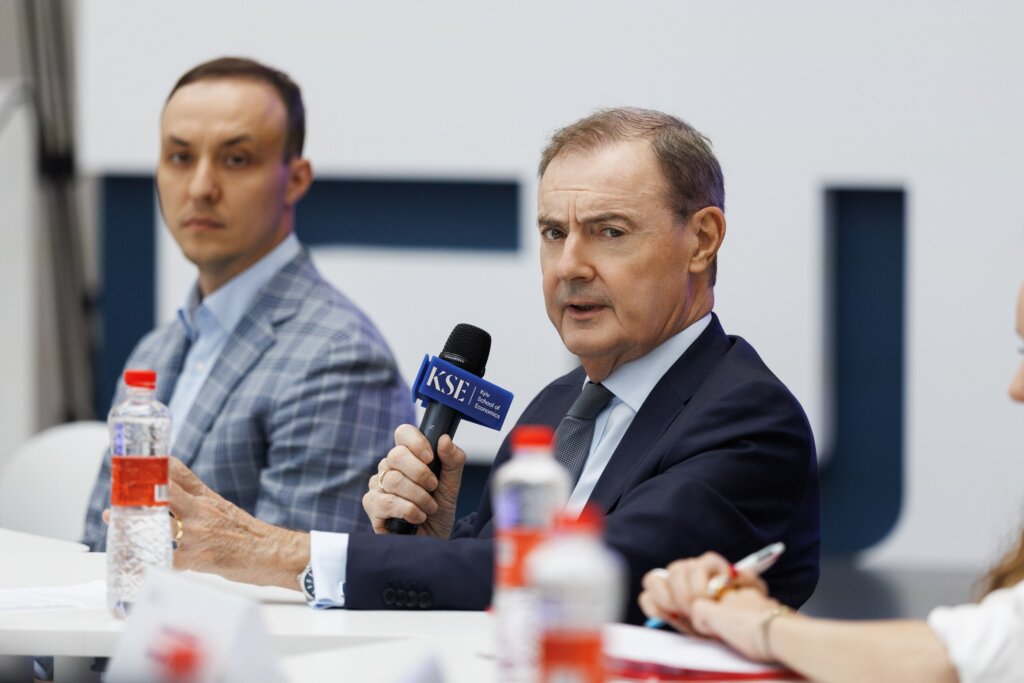
Ukraine’s Presidential Commissioner for Sanctions Policy, Vladyslav Vlasiuk, highlighted the state’s key priorities and stressed the deadly consequences of Western microelectronics continuing to reach the aggressor, emphasizing the need for stronger sanctions pressure.
“We agreed that the EU will do more — much more — to address this issue. One could say, ‘But China is the problem.’ However, if supplies from Europe were completely cut off, that alone would have a significant impact on Russia’s defense industry. We also discussed the 21st sanctions package, which we expect to be adopted next week, as well as work on the 22nd package,” Vlasiuk said.
In her remarks, NAKO Senior Researcher Viktoriia Vyshnivska focused on sanctions enforcement—the practical application of sanctions law and holding violators accountable. She stressed that the adoption of new sanctions should be accompanied by the transfer of detailed evidence to prosecutors and law enforcement agencies in the countries where offending companies are based and from which they export their products.
Vyshnivska noted that NAKO is currently conducting an in-depth analysis of this process and is seeking international partners, as such legal cases are technically complex and require extensive evidence collection to establish corporate liability.

She also raised the issue of export controls and engagement with China. According to Vyshnivska, under common sanctions circumvention schemes, a significant share of critical goods ultimately disappears into China before reaching Russia, making this route one that requires much stricter monitoring by the EU. She also urged David O’Sullivan to pay particular attention to the case of Priminer.
According to an investigation by UNITED24 Media, hundreds of high-precision computer numerical control (CNC) machine tools manufactured by the German-Chinese company Priminer continue to reach some of the most sensitive facilities within Russia’s military-industrial complex. CNC machines are critical to Russia’s defense industry, as they enable the rapid, high-precision production of components for a wide range of weapons systems, from armored vehicles to missile engines and guidance systems.
Key findings from the Priminer case
- Corporate structure: Priminer presents itself as a German-Chinese joint venture. Its headquarters are located in Neumünster, Germany, while its manufacturing facilities are based in Dongguan, China. The company’s managing directors are Feiyue Chen and Benjamin K. Kaehlcke. Priminer states that engineers from its German office are permanently stationed at the Chinese factory to oversee quality control.
- Supplies to Russian defense manufacturers: Customs records and the company’s internal reference lists covering the period from August 2021 to June 2024 document more than 100 deliveries of high-precision Priminer machining centers equipped with Siemens and Fanuc CNC systems directly to major Russian defense enterprises. Recipients include:
- JSC UZGA (manufacturer of the Forpost and Altius strike UAVs);
- JSC ENICS (manufacturer of reconnaissance and combat drones for the Russian military);
- JSC NPO Kurganpribor (producer of fuzes for artillery shells, air defense missiles, and multiple-launch rocket systems);
- Federal State Enterprise NPO KZTM (manufacturer of components for artillery and missile systems).
On February 23, 2024, the U.S. Office of Foreign Assets Control (OFAC) sanctioned Priminer’s official Russian subsidiary, Priminer Rus LLC, based in Odintsovo. However, this did not halt the supply chain. Instead, the parent company simply replaced the sanctioned importer with new intermediary companies, Olympia and Modern Technologies.
Moreover, when the Russian distributor Pumori Engineering Invest was unable to officially deliver 17 machines to the Burevestnik defense institute because of sanctions, the manufacturer resorted to a fictitious rebranding scheme. In October 2024, the parties signed an additional agreement renaming the equipment from Priminer EVO-7 to EVOLUTION EVO-7. The machines delivered to the Russian military facility in early 2025 were visually identical to the original German-Chinese models.
Sanctioning only local shell companies operating in Russia, while failing to impose meaningful restrictions on the manufacturers and beneficiaries behind these schemes in Europe, merely incentivizes companies to develop new methods of circumventing sanctions.
NAKO thanks David O’Sullivan and the European Union team for an open and substantive dialogue, as well as colleagues from the KSE Institute and other civil society organizations for coordinating joint efforts. NAKO will continue providing its research on Russian sanctions circumvention to European partners to support the preparation of future EU sanctions packages.