

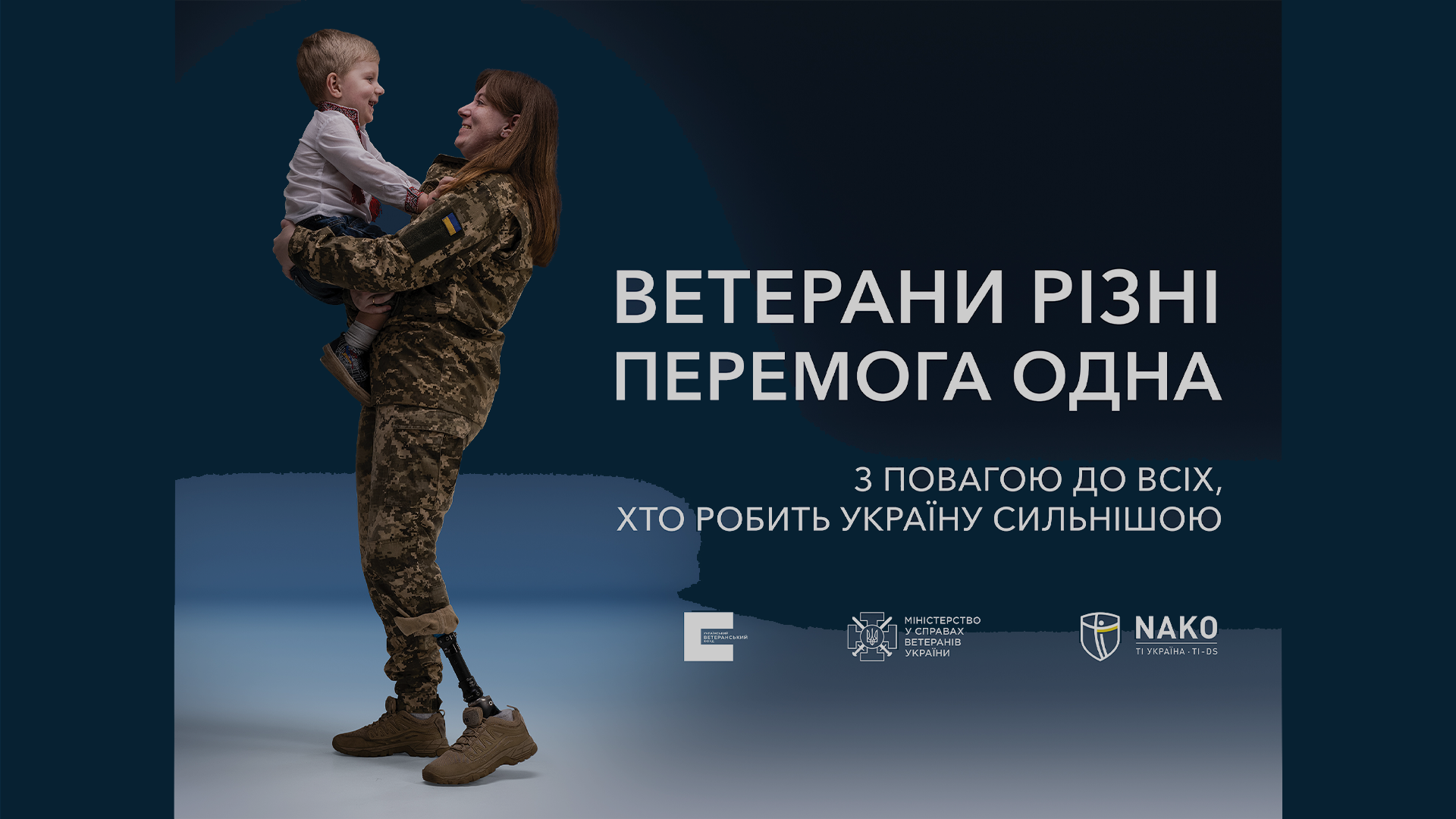
On the streets of Ukrainian cities, a series of big boards depicting Ukrainian veterans were erected to thank everyone making Ukraine stronger. That information campaign was initiated by the Ukrainian Veterans Foundation under the Ministry of Veterans Affairs as supported by the NAKO Independent Anti-Corruption Commission.
The photos for the project were made by Dmytro Kozatskyi, a popular military servant with a call sign Orest, a member of Azov regiment whose photos of Azovstal factory gained international recognition. Together with the communication team of UVF, he designed a concept of symbolic plots depicting the long-term dreams of veterans they had to postpone as the war broke out and the values they defend. It was the first pan-Ukrainian project the former POW participated in after the release from captivity.
Our society respects the veterans, they feel pride and gratitude for them. At the same time, the society cannot get rid of a range of stereotypes related to military servants, so the discrimination of various social groups in the Armed Forces of Ukraine is still a thing. It is evidenced by the results of the poll conducted by Rating sociological group entitled “Issues of Discrimination of Various Social Groups in the Armed Forces of Ukraine, March 27–29, 2023.”
The covered social positions either contradict each other directly, or cannot overcome the borders of stereotypes. The social ad “Veterans vary. Yet the victory will be common” is designed to minimize the discord. It is aimed to broadcast to the public respect, absence of discrimination, and equal attitude to the defenders of Ukraine telling about the real characters of the project.
“The attitude towards LGBT+ persons is questionable. Since the beginning of the full-scale invasion, it turned to the neutral side. However, if such a person is a Ukrainian military servant, the attitude is much better. The society supports the idea of guaranteeing equal rights for the partners of LGBT military servants, for in most cases it is positive that such military men and women are especially discriminated,” notes Ruslana Velychko-Tryfoniuk, First Deputy Executive Director of Ukrainian Veterans Foundation.
The same trend is set regarding the national minorities: the society treats them much better if they serve in the army. However, the common respondents are hesitant on the possibility of a national minority representative heading a Ukrainian military unit. At that, generally the society is positive that national minorities are not discriminated during the military service.
“According to the poll, the society mostly agrees that a woman may head a battle unit as good as a man, however, there is a belief that female military servants have more obstacles in building their careers compared to men. In addition, our fellow citizens think that a woman should rather handle non-battle tasks,” emphasizes Nataliia Kalmykova, Executive Director of the Foundation. The public offers the disabled veterans to find their place in a civil life or serve in the back units.
Olena Trehub, NAKO CEO, stresses, “We want to draw people’s attention to the fact that being loyal to Ukraine and championing the defense of our state is not the matter of gender or age.”
This social ad focuses on instilling in Ukrainians respect to veterans regardless of sex, age, nationality, or sexual orientation.
Anyway, we are all united by an irresistible urge to protect Ukraine in the state of war lasting for long nine years.
Big boards and city lights are located in seven cities of Ukraine, from north to south, from west to east. They encourage us to remember that veterans vary, yet the Victory will be common.
The project was supported by the UK’s Special Defense Advisory Team.