

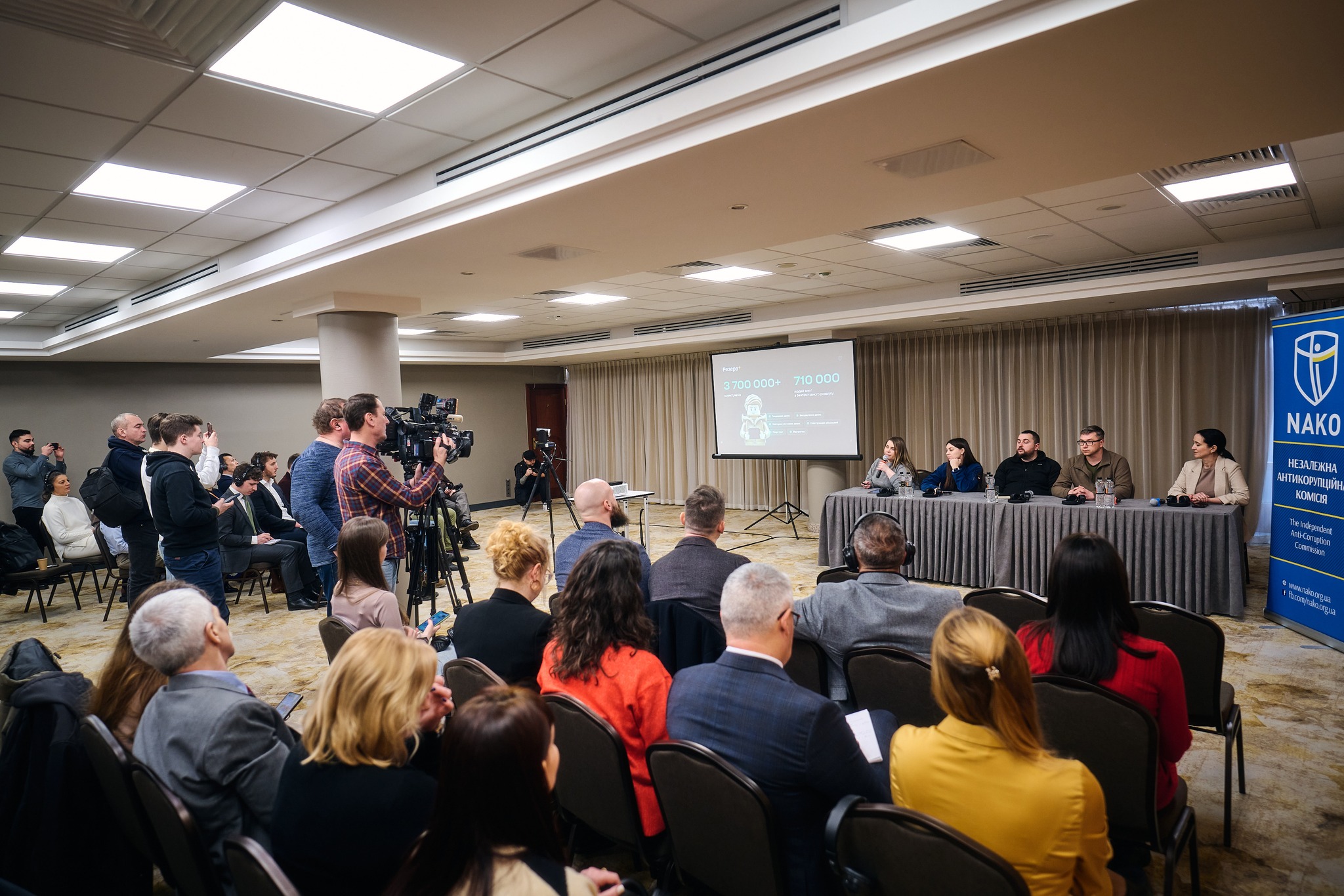
On 14 January 2025, the Independent Anti-Corruption Commission (NAKO) held a meeting in the Defence Talks format on “Digital Fronts: Transformation of the Ukrainian Defence Sector in Wartime”.
Speakers at the event included Kateryna Chernohorenko, Deputy Minister of Defenсe of Ukraine for Digital Development, Digital Transformation, and Digitalization; Alyona Zhuzha, IT Advisor at the State Logistics Operator; Taras Doroniuk, Deputy Head of the Reforms Support Office of the Ministry of Defense of Ukraine; Vitalii Masiuk, Member of the Public Anti-Corruption Council under the Ministry of Defence, expert on social and personnel policy of the Ministry of Defence, defender of servicemen’s and veterans’ rights.
The meeting was attended by some 50 military attachés, diplomats, politicians, experts and journalists.

How the Ministry of Defence is building a digital army
During her speech, Kateryna Chernohorenko talked about the digitalisation of the military. In particular, she shared the results of the use of the Ministry of Defence’s key digital products — the Reserve+ and Army+ apps and the Delta system.
According to her, Reserve+ has already been used by 3.7 million people. The app contains the largest database of military vacancies, accessed by more than 36,000 users. The deputy defence minister said this can be the key to a professional career in the Army.

Chernogorenko described the Army+ app, currently used by more than 560,000 servicemen, as a digital tool that “overcomes bureaucracy in the army.” The app’s launch was also part of the Army’s personnel reform: soldiers could change their place of service online and return after going AWOL.
Thanks to the Delta combat system, which helps track enemy targets in real-time, the Ukrainian military has already destroyed more than $15 billion worth of Russian equipment. About 1.2 million targets are added to the system every month, and according to Chernogorenko, the time from the detection of an object to the moment of defeat is seven minutes.

Digitising the Army’s logistics procurement
Alyona Zhuzha focused on how the State Logistics Operator saves money by digitising procurement processes. According to her, since its launch a year ago, the procurement agency has saved almost UAH21 billion for the state budget and redirected it to meet additional needs of the Army. This has been achieved primarily through:
- Procurement through Prozorro. For example, by the end of 2024, the DOT saved 10% on the purchase of bottled water due to competition between suppliers in the Prozorro auction.
- Implementation of the DOT-Chain IT system. The food supply cycle has been reduced fourfold — from 60 to 15 days. Approximately 30,000 documents are signed in DOT-Chain each week. Almost all Ukrainian Armed Forces military units implemented the system.
- Optimisation of DOT’s internal processes. The agency has implemented accounting and human resources systems, electronic document management, task management, etc.

Digital transformation of the defence sector: An independent expert’s view
Taras Doroniuk spoke about the role of the Ministry of Defence’s Reforms Support Office in engaging professionals in implementing technological solutions in the defence sector. This advisory body focuses primarily on facilitating processes, helping to make the most of the experience of both military and civilian personnel.
Doroniuk cited the creation of a digital repository of normative documents of the Ministry of Defence and the General Staff of the Armed Forces of Ukraine, which the Reforms Support Office worked on in 2024. This has significantly accelerated the work of the Legal Service of the Ministry of Defence and the General Staff of the AFU.
Vitalii Masiuk, a member of the Public Anti-Corruption Council, assessed the digitalisation processes in the defence and security sector in four areas:
- Warfare (for example, the Delta combat system);
- Logistics, for which the MoD procurement agencies are responsible;
- Human capital (Oberih, Reserve+ and Army+ registers);
- Resource support.
While the first three areas are developing effectively, resource support is the least digitised. Today, the MoD works mainly with analogue data and analyses information from state registers, says Masiuk.

He also called on the MoD to consider cybersecurity when developing digital products. The ministry must also explain how soldiers can use these products easily and establish direct communication with servicemen and women about their immediate needs. In addition, the MoD should already be developing practical steps to collect information on the military and integrate this data into a comprehensive system of social protection for veterans. After all, the issue of reintegrating veterans into civilian life will be an urgent one for our country, said Vitalii Masiuk.


The Defence Talks are meetings where Ukrainian government representatives, high-ranking officials, representatives of the public sector, the diplomatic corps and the media discuss key trends and challenges in the security and defence sector.
NAKO organised the Defence Talks with the support of ISAR Ednannia as part of the Civil Society Sectoral Support Initiative project.
Photos by Dmytro Holovchenko