

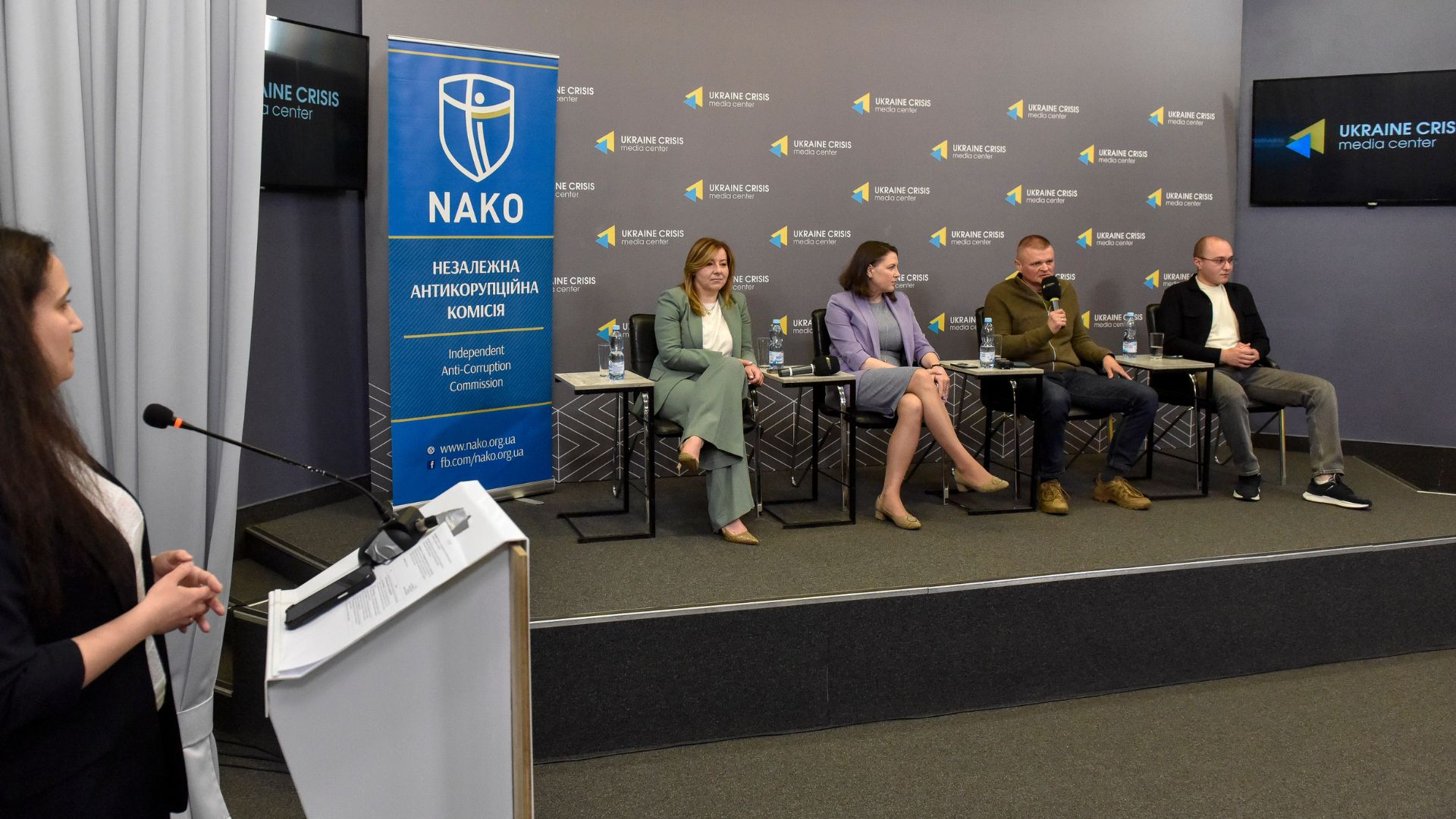
On May 21, 2025, the Independent Anti-Corruption Commission (NAKO) held a Defence Talks discussion titled “The Defense Sector and Civil Society: How to Balance Transparency and Accountability in Defense Procurement?” The event took place during Open Government Week (May 19–23), an annual international initiative that brings together government and civil society to foster democracy, increase transparency in public administration, and encourage citizen participation in decision-making.

Participants included:
- Nazar Kubov, Acting Head of the Anti-Corruption Sector, State Rear Operator
- Oleh Polishchuk, Acting Head of the Internal Control Department, Defense Procurement Agency
- Nadiya Bihun, Chair of the Supervisory Board, State Rear Operator, and former Deputy Minister of Economy of Ukraine
- Tetiana Nikolaienko, investigative journalist and Deputy Head of the Ministry of Defense’s Anti-Corruption Council (MoD ACC)

State Rear Operator’s collaboration with civil society
Nazar Kubov explained how the State Rear Operator works with the Ministry of Defense’s Anti-Corruption Council and other civil actors. Feedback from civil society, he said, helps the agency improve its operations:
“This is how we refine our procedures, increase transparency, improve the quality of rear procurement, minimize certain risks, and fully ensure our army is supplied,” Kubov said.

Inside the Defense Procurement Agency
Oleh Polishchuk noted that the agency pursues a policy of openness, holding regular meetings with foreign and Ukrainian stakeholders, including representatives of the MoD ACC. Commenting on the scandal involving defective mines that began in November 2024, he said:
“All defective mines were officially recalled and replaced. Law enforcement agencies are currently investigating these incidents as criminal cases.”

Why transparency builds trust
Nadiya Bihun emphasized that the transparent procurement model adopted in Ukraine helps build public and international trust. Speaking about the announced merger of Ukraine’s defense procurement agencies, she stressed the importance of preserving the openness already achieved by the State Rear Operator:
“I hope this consolidation will also push the Defense Procurement Agency toward greater openness, enabling broader market participation.”

A watchdog’s perspective
Tetiana Nikolaienko shared the perspective of the Ministry of Defense’s Anti-Corruption Council:
“The MoD serves neither the state nor business — we represent the public and the Armed Forces, for whom these goods are intended,” she said.

She added that the Council focuses not on the names of suppliers, but on the procurement agencies’ processes and safeguards:
“If there’s a clearly defined system of criteria and transparent procurement policies — if it’s clear and consistent, and we don’t see some getting bonus contracts while others get fines — then everything works well,” Nikolaienko noted.