

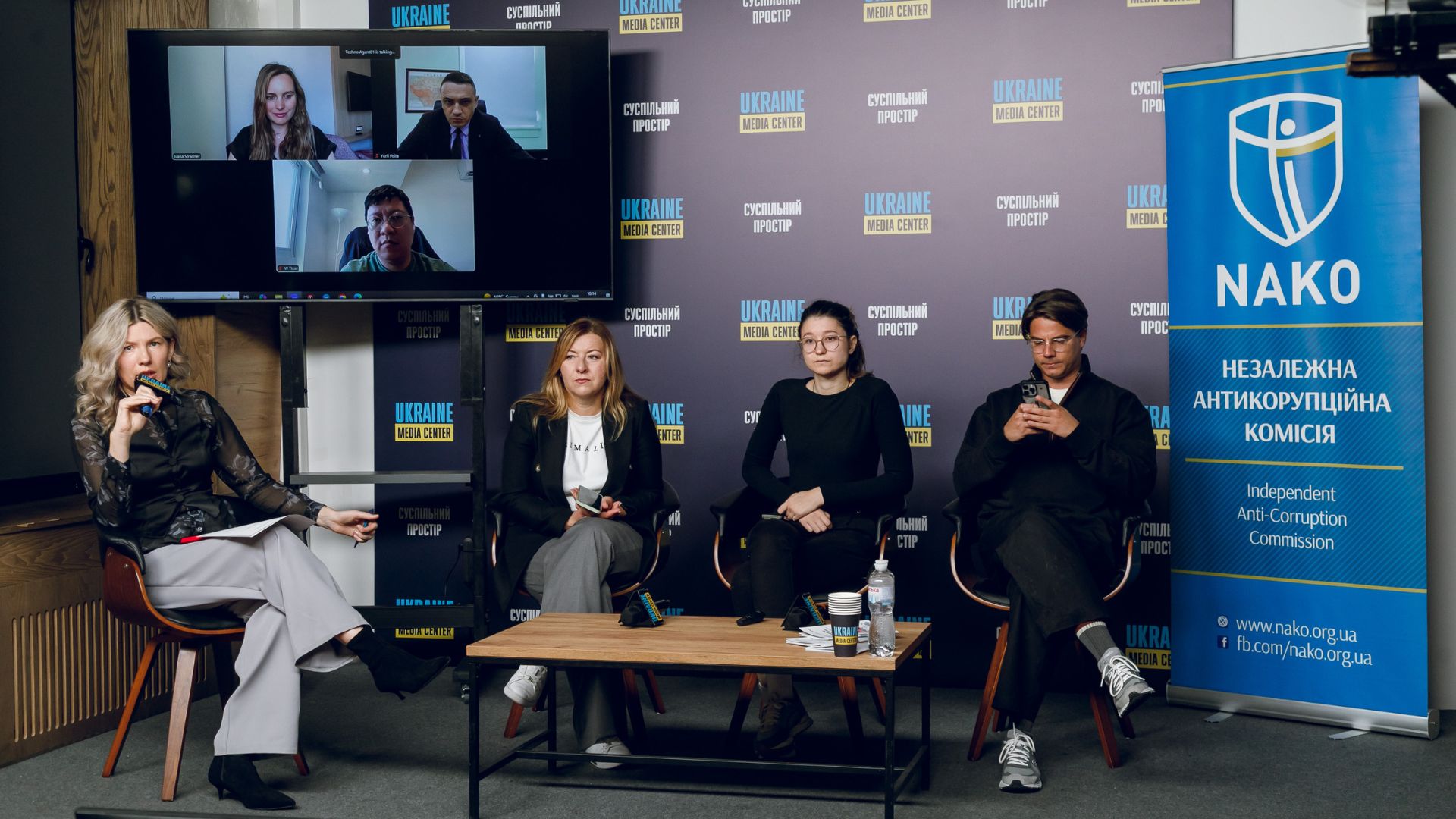
On September 25, 2025, the Independent Anti-Corruption Commission (NAKO) hosted an event titled “Democracies Under Threat: How Ukraine, the EU, the US, and Taiwan Defend the Information Space.” Experts discussed the challenges of information warfare and shared international experiences in countering disinformation. The event was attended by diplomats, media representatives, and information security professionals.
Speakers included:
- Ivana Stradner, Special Correspondent at KyivPost, Research Fellow at the Barish Center for Media Integrity, Foundation for Defense of Democracies;
- Min Hsuan Wu, Co-founder, Doublethink Lab (Taiwan);
- Yurii Poita, Head of the Asia-Pacific Section at the Center for Army, Conversion and Disarmament Studies (CACDS), Visiting Research Fellow at the Taiwan Institute for National Defense and Security Research;
- Eugene Slavnyi, Editor-in-Chief and News Director, UNITED24 Media;
- Tetiana Nikolaienko, Member of the Public Anti-Corruption Council of the Ministry of Defence of Ukraine, Senior Researcher at NAKO, journalist;
- Tetiana Chabaniuk, Head of Education Projects, Molfar Intelligence Institute.

The event was moderated by Olena Tregub, Executive Director of NAKO. “While focusing on anti-corruption activities, NAKO often encounters completely false narratives aimed at undermining trust in Ukraine. We realized that corruption as a topic plays a major role in the cognitive war now being waged between democracies and autocracies,” she noted.

Russia and China actively use disinformation to polarize the world, stressed KyivPost’s special correspondent Ivana Stradner. Western countries are increasingly recognizing that Russia sees information as a weapon of war, but they are not yet ready to treat information operations as a core element of national security. “Russia spends $2 billion annually on information operations. This is not only about influencing social media. They bribe influencers worldwide: bringing them to Russia, training them, and sending them back to spread Russian narratives. Russia has a clear strategy. And we must also rethink our approach on a systemic level,” she emphasized.

Min Hsuan Wu, Co-Founder of Doublethink Lab, spoke about China’s information influence abroad. China applies multiple strategies through media, social networks, and cooperation with governments. “When it comes to Ukraine or Western countries, the Chinese strongly support the Russians. They seek to undermine Ukrainian resistance and democracy by any means available. They use automated bot farms for information and psychological operations and spend heavily on these activities,” he noted.

Yurii Poita, representing CACDS, pointed out that in social networks, China spreads anti-Ukrainian narratives even more aggressively than in traditional media. Chinese opinion leaders attack Ukraine’s military and political leadership, use hate speech against Ukrainians, and frequently echo information from Russian media, social platforms, and politicians. “We are convinced this is a coordinated campaign. In Chinese social media, there are hundreds of such accounts, and their narratives are strongly aligned with Russian propaganda,” Poita explained.

Tetiana Nikolaienko, NAKO Senior Researcher, emphasized that Russia seeks to portray Ukraine as an extremely corrupt country. It deliberately exaggerates corruption scandals in Ukraine and pushes these false narratives to Western audiences. “During my recent visit to the US, American politicians and experts told me that we need to do something about the exaggerated perception of corruption in Ukraine, because it does exist. We must explain that Russia heavily exploits and amplifies this issue,” Nikolaienko said.

Eugene Slavnyi, Editor-in-Chief of UNITED24 Media, shared insights into the tools the outlet uses to promote its narratives abroad. “The most effective tool in this struggle is to produce strong narratives of our own. I don’t think that, like Russia and China, we need to spread disinformation. Instead, we should create popular content that unites people rather than divides them,” he stressed.

Tetiana Chabaniuk, Head of Education Projects at the Molfar Intelligence Institute, spoke about the organization’s educational initiatives and investigations in information security. She highlighted the updated school subject “Defense of Ukraine,” which now includes modules on cybersecurity and countering disinformation. “We helped develop this curriculum: we provided materials for trainers who will prepare teachers. We see, for example, how children are being recruited through various social media platforms,” Chabaniuk noted.
Photos by Media Center Ukraine