

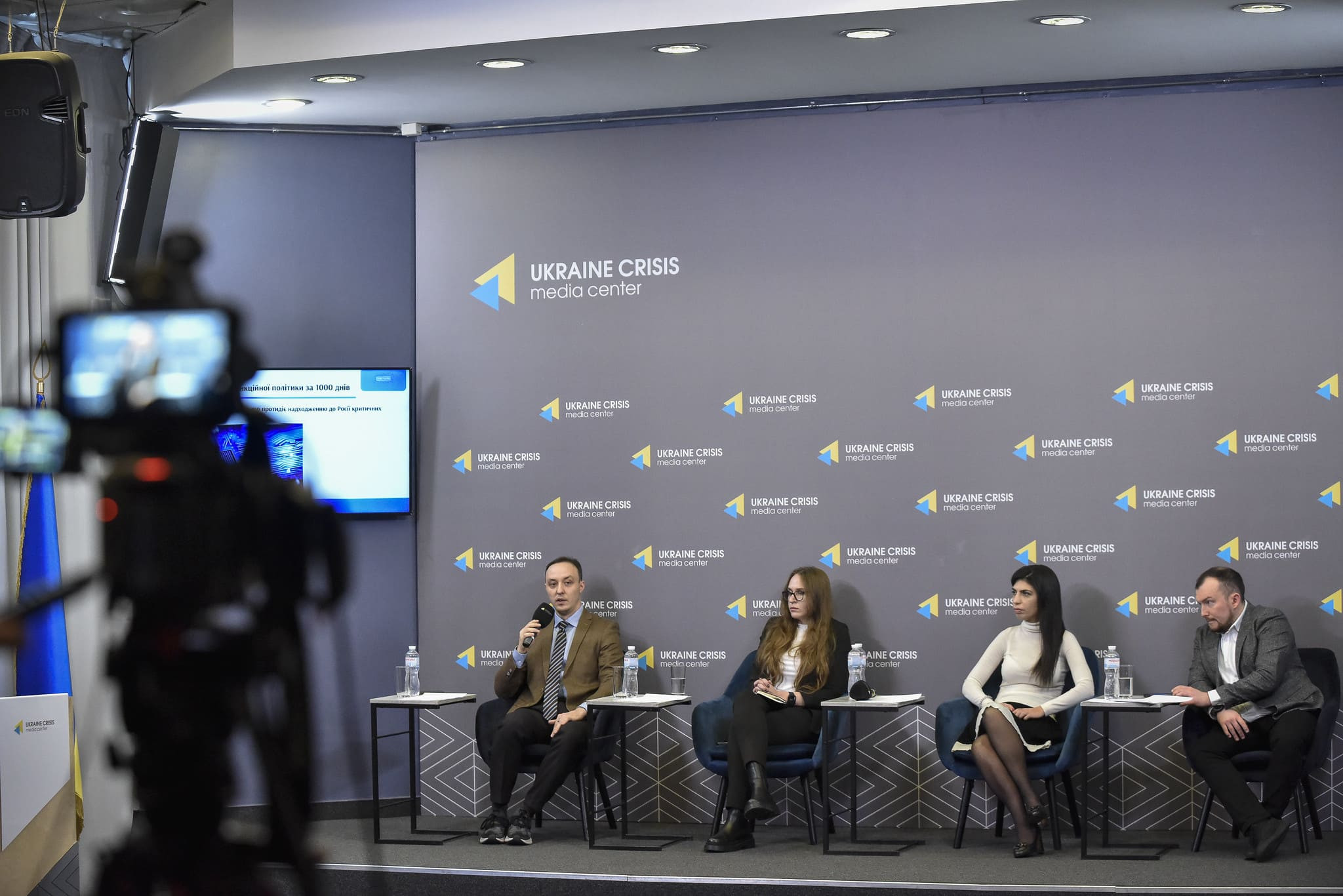
A press conference of the Public Council on Sanctions, dedicated to the sanctions policy against Russia after the start of the full-scale invasion, was held in Kyiv on 19 November. During the event, representatives of the Council presented the “Sanctions To-Do List” — recommendations from Ukrainian civil society on sanctions priorities for partner countries.

Vladyslav Vlasiuk, Presidential Commissioner for Sanctions Policy, spoke about the successes and shortcomings of the sanctions policy against Russia.
One of the main achievements of sanctions during the 1,000 days of the full-scale war was the EU oil embargo, which led to a significant reduction in Russia’s oil revenues. However, the dependence of some partners on pipeline oil creates gaps in the oil embargo. In addition, Russia is actively using its ‘shadow fleet’ to evade sanctions. “So far, the logic and legal framework of international shipping on the high seas does not allow sanctions to effectively influence the formation of the shadow tanker fleet,” Vlasiuk explained.
Many countries have begun to apply a list of components that are critical to the Russian military industrial complex and that are subject to enhanced export controls. Russia has lost access to state assets: a total of about $300 billion has been frozen in Western countries. Other achievements include the negative impact of sanctions on Russia’s aviation, engineering and timber industries; individual sanctions against various categories of people (oligarchs, the military-industrial complex, financial institutions, etc.).
Vlasiuk also outlined some of the problems with sanctions restrictions. He highlighted the underestimated role of Russian propaganda. As a result, many propagandists have not yet been sanctioned. International companies continue to operate in Russia. “De facto, companies involved in oil extraction technologies have not left. We had hoped that the withdrawal and loss of oil production technologies would significantly reduce the amount of oil and increase its cost. But this has not happened,” Vlasiuk said.
The European Union has not yet given up on Russian liquefied natural gas (LNG). On the contrary, some countries increased the pace of LNG purchases as soon as the EU started promoting the idea of a complete phase-out of Russian gas. EU countries also continue to buy Russian metals and oilfield equipment, even though Ukraine can replace them with its own products.

The recommendations of the Public Council on Sanctions were presented by Viktoriia Vyshnivska, Senior Researcher at the Independent Anti-Corruption Commission (NAKO). She outlined four areas for change in sanctions policy towards Russia:
- Restricting access to mineral resources used by the Russian military-industrial complex and expanding the list of critical components;
- Introducing changes in the energy and logistics sector: blocking the “shadow fleet”, expanding sanctions on Rosatom and modernising the crude oil price cap mechanism;
- Increase sanctions pressure on intelligence officers and propagandists, impose sanctions on ship owners and crews of the “shadow fleet”;
- strengthen the monitoring of the effectiveness of the sanctions policy. According to Vyshnivska, the Council proposes various mechanisms for re-evaluating sanctions, both by introducing separate systems and by revising specific standards.
“Governments of partner countries do not have sufficient capacity to effectively implement their own sanctions policies. The challenges posed by Russia, Iran and North Korea are now disproportionate to their capabilities. Our partners simply do not have the time to meet all the requirements of an effective sanctions policy,” said Viktoriia Vyshnivska. That is why it is important to constantly monitor the effectiveness of sanctions and to strengthen cooperation at the international level, she concluded.
Full list of recommendations available by following link.

Agiya Zagrebelska, Director of Partnership Development at the Economic Security Council of Ukraine, explained in which industries restrictions should be introduced first. As of today, the Russian military-industrial complex remains dependent on Western microelectronics and machine tools. Another priority for the countries of the sanctions coalition should be to restrict access to minerals and raw materials. “For most of the resources required for the Russian military-industrial complex, we see that Russia is able to provide itself with about 50%, often even less. It imports the rest,” Zagrebelskaya said. According to her, the partners can work in these areas for the next few years.


Oleksandr Lemenov, founder of StateWatch/Trap Agressor, focused on the problem of the “shadow fleet” and the effectiveness of energy sanctions. According to him, it is impossible to completely remove Russia from the oil market, as this would have negative consequences for the global economy. “It should be understood that the oil and gas sanctions are not aimed at completely removing Russia from the market or destroying the Russian economy. No, they are aimed at reducing the amount of money spent on the war,” Lemenov said. Nevertheless, it is important to control Russia’s energy exports and further expand sanctions in the energy sector.
The Civil Society Council on Sanctions was established to coordinate the efforts of government representatives and civil society for joint advocacy in implementing and updating restrictions against Russia and its partners. The Council includes the following organisations: the National Interests Defense Network “ANTS,” Black Sea News and the Institute for Black Sea Strategic Studies, DiXi Group, the Institute of Legislative Ideas, ICUV (International Center for Ukrainian Victory), KSE Institute, OSINT Agency Molfar, the Independent Anti-Corruption Commission (NAKO), the Economic Security Council of Ukraine (ESCU), the Center for Global Studies “Strategy XXI,” StateWatch/Trap Aggressor, Razom We Stand, and the NGO “Ukrainian Analytical Center U8.”