

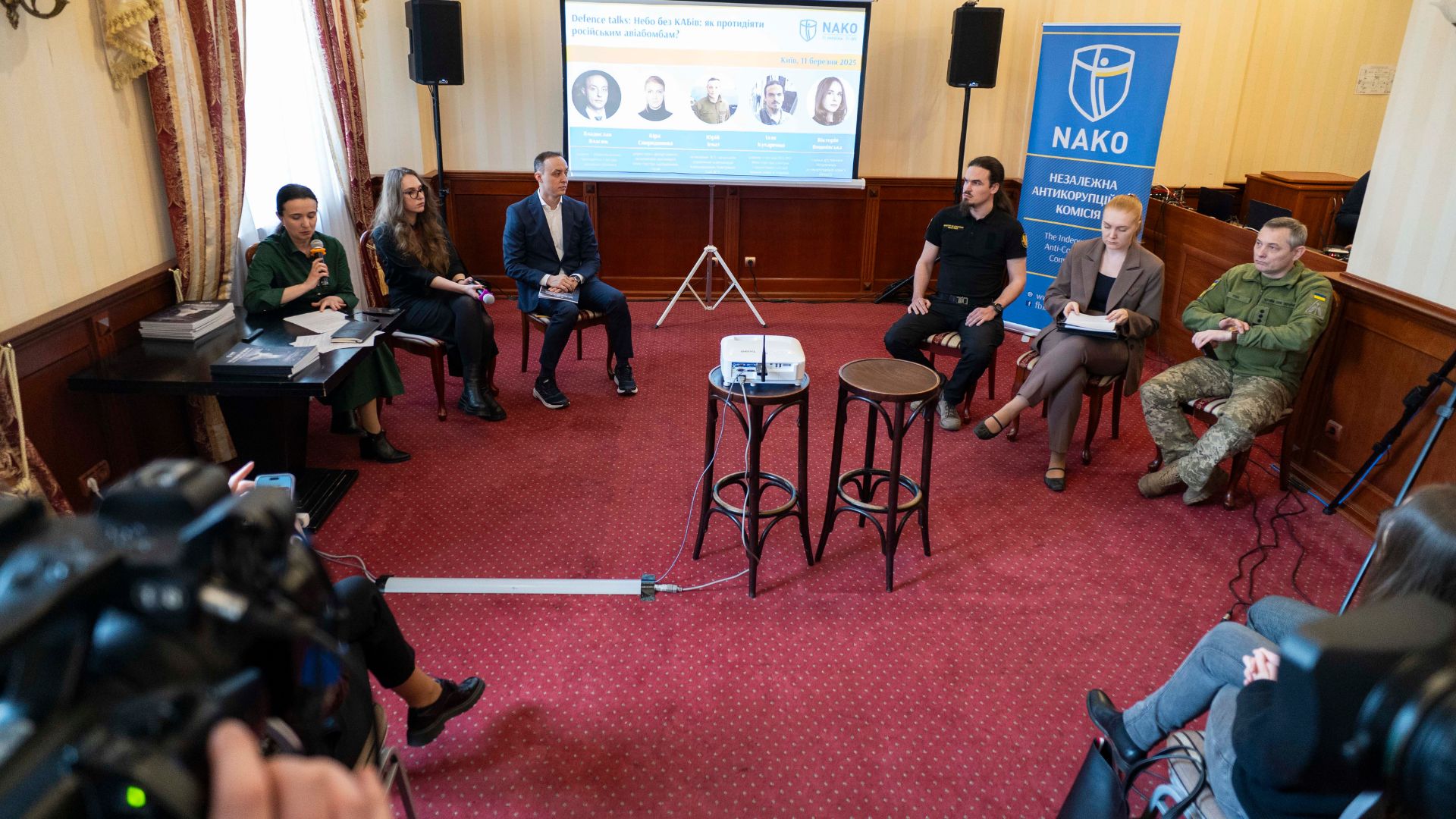
On 11 March 2025, the Independent Anti-Corruption Commission held another Defence Talks meeting on how to counter Russian aerial bombs. The event was attended by military attachés, defence experts, diplomats and the media.

Speakers at the event included Vladyslav Vlasiuk, Presidential Commissioner for Sanctions Policy; Kira Spyrydonova, Director of the Department General for Economic Diplomacy of the Ministry of Foreign Affairs; Viktoriia Vyshnivska, NAKO Senior Researcher; Illia Kukharenko, EW / SIGINT Advisor to the Ministry of Strategic Industries of Ukraine; Yuriy Ignat, Head of Communications at the Air Force Command of the Ukrainian Armed Forces. They discussed how Ukraine can counter glide bombs both at the manufacturing stage and on the battlefield.
Sanctions against aerial bombs

One of the possible keys to countering the production of glide bombs, as well as the production of other munitions, is the introduction of sanctions and export controls, said Vladyslav Vlasiuk, Presidential Commissioner for Sanctions Policy. According to him, these measures sometimes make it impossible to supply critical components to the Russian military-industrial complex, sometimes make access to components more difficult, or at least increase the price many times over. In the case of the glide bombs, the problem is that foreign components for these bombs are simple and relatively cheap, making it much easier for Russia to gain access to them.
According to Vlasyuk, the list of critical components is currently quite exhaustive, while the problem of insufficient compliance with sanctions restrictions is acute. He also stressed the importance of financial sanctions: “Money between Russian manufacturers and suppliers is not carried in suitcases or in cash. Sometimes it is, as with Iran, but for the most part it is still transferred through the financial system, whether through banks, cryptocurrencies, etc. So there is a big opportunity here to tighten sanctions restrictions.”

For her part, Kira Spyrydonova, Director of the Department General for Economic Diplomacy of the Ministry of Foreign Affairs, spoke about the three main areas of the sanctions policy of the MFA:
- sanctions coalition, i.e. coordinating sanctions policy with partner states in order to maximise pressure on Russia in different directions;
- sanctions synchronisation, in particular, taking into account restrictions imposed by other states and informing partners about Ukrainian sanctions;
- countering sanctions evasion, i.e. introducing restrictions on individuals and companies who help Russia to obtain sanctioned goods. According to the MFA representative, this is one of the most promising areas for the near future.
For example, the EU's 16th sanctions package includes a significant number of Ukraine's proposals, Spyrydonova said. "We appreciate the support of our partners in this regard, that they listen to us, that they take this into account in their packages. And we see the results of both our work and the work of our intelligence services, who help us in this, as well as the cooperation with our partners," she said.
Separately, Kira Spyrydonova noted that the MFA often refers to NAKO's research, which includes information from open sources, to persuade partners to impose sanctions on specific companies.
Foreign components in Russian bombs: NAKO report

NAKO Senior Researcher Viktoriia Vyshnivska presented the NAKO research 'The Makers of Ruin: Glide Bombs, UMPK and Their Civilian Cost'. According to Vyshnivska, Russia has significantly increased its use of glide bombs in recent years, from 10,000 bombs in 2023 to almost 40,000 in 2024.
As Viktoriia Vyshnivska explained, in the report, NAKO analysts first examined the universal planning and correction module (UMPK), the main part of the bomb that is responsible for its controllability. They also examined 26 plants involved in the production of various parts of the bombs. "Given the modernisation, the increase in the production of glide bombs, it is likely that the number of such companies is increasing. In this context, the saddest thing is that all these companies are sanctioned in different ways by our international partners," said Viktoriia.
When analysing the supply of microelectronics to Russia, NAKO experts identified more than a thousand top Russian importers, 97% of which are private companies. According to Vyshnivska, there is a certain trend that these importers are often not even formally connected to microelectronics or the military-industrial complex. Sometimes they are companies that make mattresses, raise poultry or resell frozen food.

Illia Kukharenko, EW / SIGINT Advisor to the Ministry of Strategic Industries of Ukraine, outlined the specifics of electronic warfare as one of the most effective tools against glide bombs. He explained that there are three key electronic components in the UMPC:
- controller—a simple and common component used in everything from washing machines to refrigerators;
- inertial navigation system, which is fully autonomous;
- satellite navigation system, which is a Kometa device consisting of antennas and a Global Navigation Satellite System (GNSS) receiver.
"You have all heard that there are Kometas with 4 and 8 elements, there are already 12 and soon there will be 16. This number of elements helps the antenna to protect itself from a certain number of EW transmitters on the ground. Normally the N-1 rule applies. If we have a 4-element Kometa, we need three electronic warfare devices distributed in space to reliably suppress it," explained Illia Kukharenko.
He emphasised that it is not enough to simply assemble electronic warfare devices in one place, but to place them correctly. "In order for electronic warfare to be effective against glide bombs, we need to saturate a certain depth, up to 40 kilometres or more, with electronic warfare assets so that they are distributed in space. And then we can really fight the Kometa with good efficiency," Kukharenko said.
According to him, Ukrainian manufacturers have so far managed to do several things: supplying the front line with a significant number of electronic warfare systems, developing a centralised control system and providing administrative measures (such as uninterrupted power supply and security for electronic warfare equipment).

Yuriy Ignat, Head of Communications at the Air Force Command of the Ukrainian Armed Forces, spoke about how Ukrainian aviation fights Russian glide bombs. In his opinion, the key to success is first and foremost the destruction of the carrier aircraft. In particular, he recalled the successful use of the Patriot air defence system to destroy two Russian aircraft and three helicopters in the Bryansk region of Russia in May 2023. "Where the Patriot worked, Russian aircraft did not appear for a long time. For several months. They studied, they watched. That's the countermeasure. The enemy, knowing that it can be destroyed, does not approach," he said.
Powerful aviation is a step towards success on the ground, Ignat stressed. A comprehensive approach is needed to counter Russian aircraft with glide bombs, including advanced fighters, air defence systems, electronic warfare, airborne radar, air-to-air missiles, etc.
We are grateful to the Prague Civil Society Centre and the International Renaissance Foundation for their support in the organisation of the Defence Talks.