

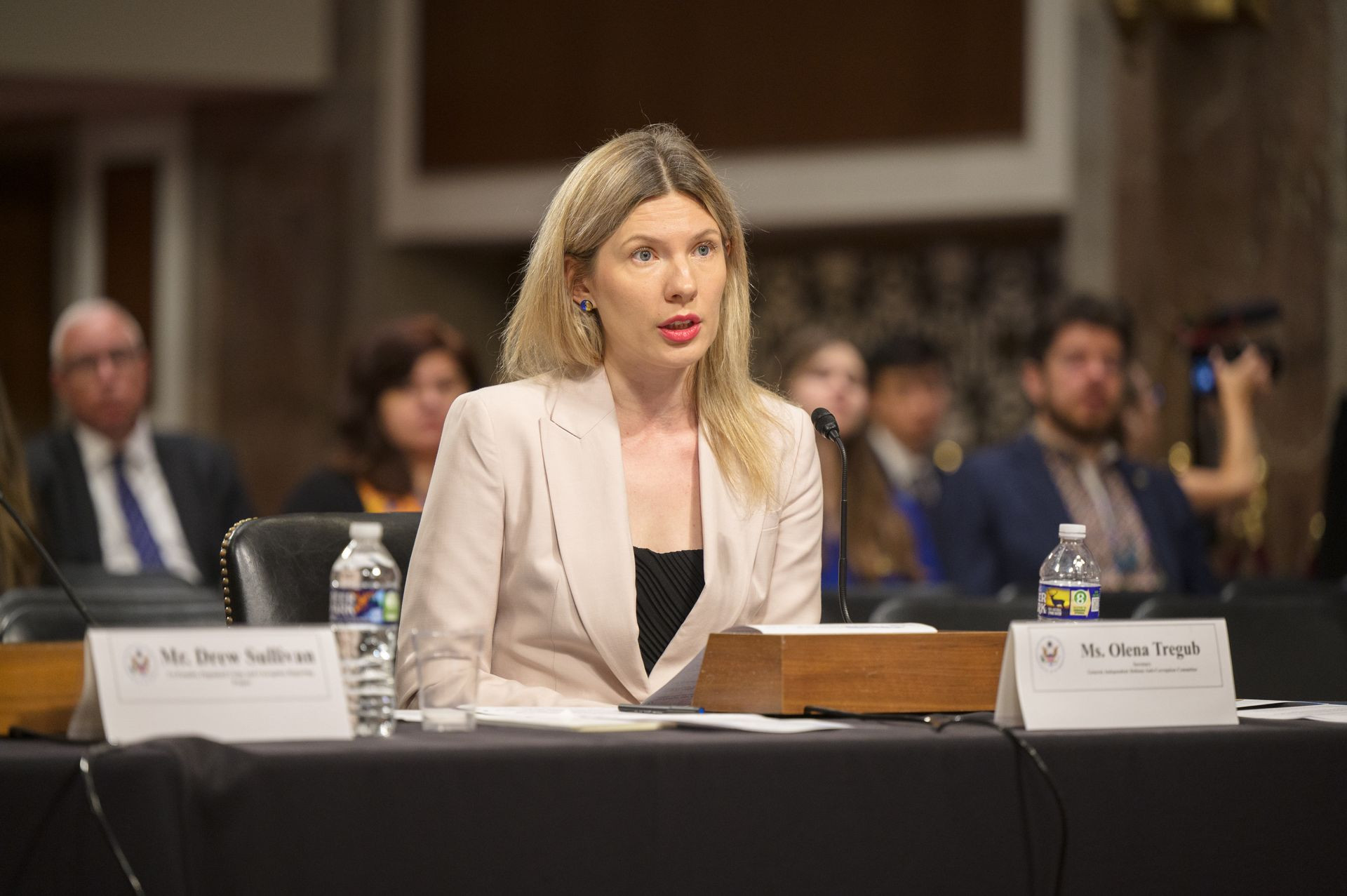
On July 18, 2023, Olena Tregub testified to the U.S. Helsinki Commission during the “Russia’s Alpine Assets: Money Laundering and Sanctions Evasion in Switzerland” Hearing.
She emphasized that Swiss policy does not look neutral, limiting armaments for Ukraine, the government not noticing Russian assets, helping Russians launder the money, and not contributing enough to stop the supply of the components to Russia via third countries.
It is no secret Switzerland became a refugee centre for Russian elites. Switzerland offers a few advantages: strict secrecy laws, loopholes in preventing money laundering and financial crime, and an unregulated commodity trading system. While the government of Switzerland has joined the US and Europe in the sanctions against Russia, we understand that these measures cover only the tip of the iceberg of Putin's valuable allies. Switzerland says it knows of $48.5 billion in Russian assets. The banks’ estimates are higher – more than $200 billion. Various independent analyses, however, claim it is above $400 billion, Tregub said this during her speech in the US Congress.
While the Swiss government takes its time pondering whether or not Switzerland wants to investigate how the Russians under sanctions evade them, we see more and more reports coming on the assets Russians are hiding there. The government of Switzerland refuses to be part of the working group (a European task force) that searches for Russian assets. Why so? Is it because some Russian oligarchs and politicians still are able to hide in Switzerland, even allegedly Alina Kabayeva and her kids? Frankly, if the media and the people believe it, the government prefers not to look deeper into it.
Switzerland is a neutral country, and the debate regarding weapons supply to the countries at war has been off the table long before the war in Ukraine. The nature of the Russian invasion made people and governments question their beliefs. As of the beginning of 2023, 55% of people in Switzerland favoured lifting the ban on the export of their weapons. Yet, the ban remains.
At the same time, according to our recent analysis of 22 pieces of Russian weapons and military equipment, semiconductors produced by Swiss companies can be found in numerous systems used by the Russian Army, including Kalibr missile, Alligator Ka-52 battle helicopter, Kh-101 missiles, surveillance and kamikaze UAVs Korsar, Orlan, Shahed-136, etc.
The presence of components made by STMicroelectronics, U-Blox, TE Connectivity, and TRACO Electronics makes Switzerland a leading European country in this regard.
In response to the invasion of Ukraine in March 2022, Switzerland and other Western countries restricted the opportunity to supply Russia with essential electronics and semiconductors needed to sustain war efforts. All of these companies are said to have terminated their trade activity with Russia. Yet the investigations prove otherwise. Despite sanctions and export control restrictions, those components still end up in Russia via intermediaries in third countries, e.g. China and Turkey. For example, U-Blox, a Zurich-based world-leading microchip manufacturer, made 14 shipments of such critical goods, including the navigation module, to Russia through several Chinese companies (shell companies created by Russian citizens after 2014) to a Russian company SMT-ILogic. Multiple reports have linked this company with “The Special Technological Center”, a known manufacturer of Orlan UAVs. With the delay, Switzerland did sanction SMT-ILogic on January 25, 2023 – almost a year into the full-scale invasion. Even more striking example is that the Swiss company “Galika AG” with several Russian subsidiaries sanctioned by the US back in 2014 for supplying Russian military factories with Swiss machinery, was still operating and not sanctioned by Switzerland as of April 2023, according to Swiss journalists.
This situation is not unique to Switzerland only – this is an export control challenge for all the countries in the coalition, including the U.S.
Yet when it comes to the government of Switzerland, it appears indecisive in its policies regarding Ukraine, keeping the ban on the re-export of Swiss-made weapons to Ukraine, but sees no problem in their companies supplying components for Russian weapons. If Switzerland is so principled about not being part of any armed conflict in the world, why is it not enforcing measures to stop the supply of its critical components to Russian and Iranian weapons?
Feeding the Russian war machine with its technology while denying weapons to Ukraine does not look like true neutrality, – Tregub concluded.
The Commission on Security and Cooperation in Europe, better known as Helsinki Commission, was created by the US Congress in 1975 to monitor compliance with the obligations of the OSCE, in particular the Helsinki Agreements. Nine Commissioners are members of the Senate, nine are members of the House of Representatives, and three are executive branch officials. This hearing builds on years of work by the Commission to hold Switzerland to account for its role in Russian money laundering and corruption.
She emphasized that Swiss policy does not look neutral, limiting armaments for Ukraine, the government not noticing Russian assets, helping Russians launder the money, and not contributing enough to stop the supply of the components to Russia via third countries.
It is no secret Switzerland became a refugee centre for Russian elites. Switzerland offers a few advantages: strict secrecy laws, loopholes in preventing money laundering and financial crime, and an unregulated commodity trading system. While the government of Switzerland has joined the US and Europe in the sanctions against Russia, we understand that these measures cover only the tip of the iceberg of Putin's valuable allies. Switzerland says it knows of $48.5 billion in Russian assets. The banks’ estimates are higher – more than $200 billion. Various independent analyses, however, claim it is above $400 billion, Tregub said this during her speech in the US Congress.
While the Swiss government takes its time pondering whether or not Switzerland wants to investigate how the Russians under sanctions evade them, we see more and more reports coming on the assets Russians are hiding there. The government of Switzerland refuses to be part of the working group (a European task force) that searches for Russian assets. Why so? Is it because some Russian oligarchs and politicians still are able to hide in Switzerland, even allegedly Alina Kabayeva and her kids? Frankly, if the media and the people believe it, the government prefers not to look deeper into it.
Switzerland is a neutral country, and the debate regarding weapons supply to the countries at war has been off the table long before the war in Ukraine. The nature of the Russian invasion made people and governments question their beliefs. As of the beginning of 2023, 55% of people in Switzerland favoured lifting the ban on the export of their weapons. Yet, the ban remains.
At the same time, according to our recent analysis of 22 pieces of Russian weapons and military equipment, semiconductors produced by Swiss companies can be found in numerous systems used by the Russian Army, including Kalibr missile, Alligator Ka-52 battle helicopter, Kh-101 missiles, surveillance and kamikaze UAVs Korsar, Orlan, Shahed-136, etc.
The presence of components made by STMicroelectronics, U-Blox, TE Connectivity, and TRACO Electronics makes Switzerland a leading European country in this regard.
In response to the invasion of Ukraine in March 2022, Switzerland and other Western countries restricted the opportunity to supply Russia with essential electronics and semiconductors needed to sustain war efforts. All of these companies are said to have terminated their trade activity with Russia. Yet the investigations prove otherwise. Despite sanctions and export control restrictions, those components still end up in Russia via intermediaries in third countries, e.g. China and Turkey. For example, U-Blox, a Zurich-based world-leading microchip manufacturer, made 14 shipments of such critical goods, including the navigation module, to Russia through several Chinese companies (shell companies created by Russian citizens after 2014) to a Russian company SMT-ILogic. Multiple reports have linked this company with “The Special Technological Center”, a known manufacturer of Orlan UAVs. With the delay, Switzerland did sanction SMT-ILogic on January 25, 2023 – almost a year into the full-scale invasion. Even more striking example is that the Swiss company “Galika AG” with several Russian subsidiaries sanctioned by the US back in 2014 for supplying Russian military factories with Swiss machinery, was still operating and not sanctioned by Switzerland as of April 2023, according to Swiss journalists.
This situation is not unique to Switzerland only – this is an export control challenge for all the countries in the coalition, including the U.S.
Yet when it comes to the government of Switzerland, it appears indecisive in its policies regarding Ukraine, keeping the ban on the re-export of Swiss-made weapons to Ukraine, but sees no problem in their companies supplying components for Russian weapons. If Switzerland is so principled about not being part of any armed conflict in the world, why is it not enforcing measures to stop the supply of its critical components to Russian and Iranian weapons?
Feeding the Russian war machine with its technology while denying weapons to Ukraine does not look like true neutrality, – Tregub concluded.
The Commission on Security and Cooperation in Europe, better known as Helsinki Commission, was created by the US Congress in 1975 to monitor compliance with the obligations of the OSCE, in particular the Helsinki Agreements. Nine Commissioners are members of the Senate, nine are members of the House of Representatives, and three are executive branch officials. This hearing builds on years of work by the Commission to hold Switzerland to account for its role in Russian money laundering and corruption.