

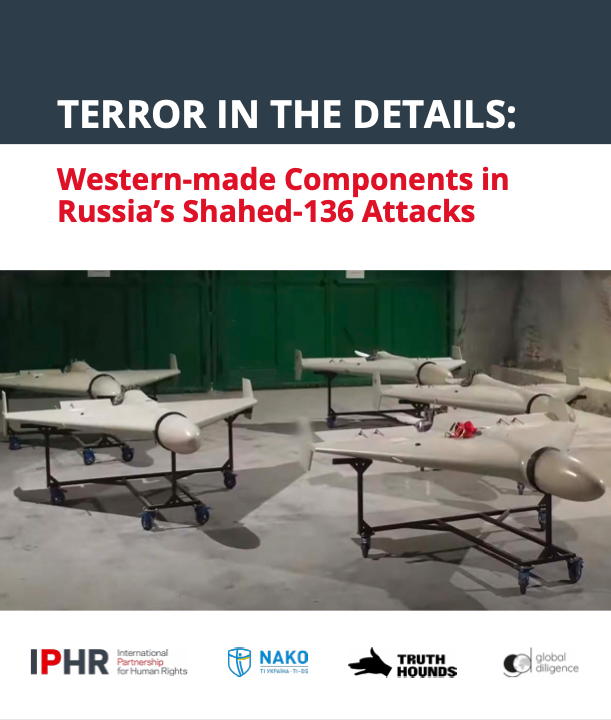
A new report has found that Russian forces have used Iranian-made Shahed-136 UAVs that contain Western components to commit suspected war crimes in Ukraine.
Co-authored by the International Partnership for Human Rights (IPHR), the Independent Anti-Corruption Commission (NAKO), Truth Hounds, and Global Diligence LLP, and entitled, ‘Terror in the details: Western-made Components in Russia’s Shahed-136 Attacks’, the report details ten attacks where the Shahed-136 was found to have been involved. The attacks targeted residential buildings, power plants, businesses, a school and a children’s summer camp. In each instance, the report examines the context of the attack, the presence of military objects or activity in the vicinity of target, and the means by which they have identified the Shahed-136 as being used.
The report finds that Russia’s Shahed-136 attacks are intentionally aimed at the civilian population and infrastructure, with no tangible military advantage gained as a result of the attacks; the primary purpose is deemed to be terrorising the civilian population.
Multiple Shahed-136 fuselages that have been used by Russia in Ukraine were also analysed. They contained a variety of components manufactured by American, Japanese, Canadian, and Swiss companies, ranging from microprocessors and semiconductors to ethernet transceivers and memory.
The report sounds the alarm as to the Russian military’s reliance on Western-made components in its war against Ukraine and the urgent need to restrict the continued supply of such components. It provides comprehensive recommendations across sanctions and export controls, including enforcement, corporate due diligence and know-your-customer procedures, as well as diplomatic coordination to effectively exploit Russia’s reliance upon Western components, described as its “Achilles heel.”
Note to editors:
- The suspected war crime case studies were drawn from a dataset of 25 attacks since September 2022 found to have utilised the Shahed-136. This dataset was based on open-source reporting and evidence collected by Truth Hounds’ field teams.
- Each case study was categorised based on the type of suspected breach of international humanitarian law, with accompanying footage and other evidence geolocated, verified, and archived.
- The authors of the report are not imputing legal wrongdoing on the part of companies named throughout. An assessment of any legal consequence to having manufactured a component used inside a weapon used by Russia as part of a suspected war crime is outside the scope of the report. The report is released for the sole purpose of highlighting moral and ethical concerns, encouraging further discussion, and calling for better business due diligence and risk assessment.
- For all media enquiries, contact [email protected]