

On November 2, 2023, the U.S. imposed new sanctions against 130 entities and individuals responsible for assisting Russia in sanction evasion. The list includes people and companies from Turkey, China, UAE, and Russia engaged in the import of Western technology necessary for Russia to maintain its war efforts.
Sanctioning has been one of the key measures in response to both invasions of Ukraine: first in 2014 and 2022. Yet, the harshness and effectiveness of these sanctions, especially in response to the full-scale invasion, remains a debatable and controversial topic for discussion. On the one hand, the initial post-February-24th sanctions did work in a way – the evidence would be the challenges the Russian government had and still has to go through to manage the consequences and bypass the restrictions. Even the repetitiveness with which the Russian officials demand lifting the said sanctions, if not proves the full effectiveness, then at least highlights the obvious discomfort.
Yet, on the other hand, it clearly did not stop the Russian economy nor its capabilities to wage war against Ukraine. In fact, albeit more challenging, Russia can still supply its military industry with crucial technological necessities for more or less basic army needs and manufacturing more sophisticated weapon systems.
There are numerous reasons for such developments: loopholes, countless intermediaries all around the world, favouring policies within some countries, lack of capacity to monitor the impact of the already imposed sanctions, a wide variety of areas that need to be covered and the general lack of a well-built, consistent and mutually complementary policy within the Western countries.
In particular, the consistency of different sanctions regimes has been one of the least explored areas of analysis, even more so if the analysis pertains to one of the cores of Russian military efforts – its military industry. The sanctioning of the monster of the Russian state’s military industry – Rostec – would be an excellent example of the inconsistency in the context of Ukrainian partners and Ukraine itself. The absolute majority of sanctions imposed against Rostec originated shortly after February 24th (EU, UK, Canada, Australia, Japan and New Zealand), and, in the case of Switzerland – a year and a half into the invasion – in the middle of 2023. The only countries that sanctioned Rostec before were Ukraine and the US. Interestingly, Ukrainian sanctions were imposed seven years after the American ones: while the States had imposed the restrictive measures back in 2014, the Ukrainian government made the same decision only in 2021.
A case of an almost decade-long sanctioning of such a hard-to-notice entity as Rostec raises a question: how consistent the sanctioning policies are in targeting the Russian military industry?
NAKO has analysed a modest portion of the prioritised Russian entities and the individuals involved in maintaining the war efforts. Considering the impossibility of comprehensively covering the list of each entity related to the Russian military industry and/or other companies assisting other Russian companies, the sampling of this analysis could not be considered representative enough to make solid conclusions on the overall state of consistency in sanctioning the military industry of Russia and all derivative branches of its global supply network.
Our analysis is based on two primary sources. The first one is a selected list of 338 prioritised entities involved in the Russian military industry as either producers or intermediary suppliers. This list excludes well-known examples and consists of more middle-level companies. The second one is a publically available list of 305 people engaged in the military-industrial complex from NAZK’s database.
Sanctioning the companies
The list of entities directly or indirectly involved in maintaining the Russian military-industrial complex is nearly endless. Some companies operate as an official part of the Russian military-industrial complex: smaller parts of Rostec, state-owned plants responsible for explosives or specific military systems and, of course, the intermediaries – the ones that can often be seen in journalistic investigations about sanction evasion. One of the most known ones is SMT-ILogic – a notorious Russian electronics import company that shares the same address as the producer of Orlan-10 drones. In December 2022, Reuters reported this company had imported numerous western microchips (primarily by Analog Devices, Texas Instruments and Xilinx) worth at least $2.6 million.
It has been almost a year since the investigation, yet the company remains unsanctioned by the EU and numerous other jurisdictions. In general, the sanctioning of SMT-ILogic began only at the end of spring of 2023: starting with Ukraine and slowly, almost month-by-monthly, covering the sanctions list of the UK, Switzerland, the US and Canada.
The example of SMT-ILogic is one of the most known ones, while Russia is full of similar companies. They emerge and disappear relatively quickly, and by the time the company reaches at least one of the sanctions list, it may not necessarily be functioning anymore. But more importantly, it is to acknowledge the existence of an even more significant gap in sanctioning than just the inability to cover all the shell companies and intermediaries in a short period of time in a well-coordinated fashion for all the jurisdictions.
It is the very width of coverage with sanctions. The common approach to sanctioning Russia is sectoral-based – the measures are expected to cover a particular industry as a whole. Therefore, Rostec, as an enormous defence umbrella company, is the easy target to restrict, after which go Rostec’s holding companies, such as JSC Kalashnikov Concern (sanctioned in 2014) or Uralvagonzavod (sanctioned in 2022), while numerous smaller, yet significant companies remain unsanctioned.
For instance, a Yekaterinburg-based JSC Ural Plant of Transport Mechanical Engineering (known as UralTransMash) is a part of the said Uralvagonzavod and, therefore, a part of Rostec as well. This company manufactures mainly railway products such as tram cars or rocking machines. However, it is also the primary producer of Msta-S and Msta-SM2 self-propelled howitzers, used actively on the battlefield against Ukraine. But the only countries to sanction UralTransMash so far were Ukraine and the US, while its colleague plant, JSC Zavod No. 9, which is said to be the central manufacturer of cannon artillery equipment, was sanctioned by Ukraine only. Hence, a part of sanctioned Rostec and Uralvagonzavod remains relatively safe and sound in its financial activity.
Another example would be the Kazan Gunpowder Plant, whose production is heavily used for military purposes. Unlike UralTransMash, this ammunition plant is a federal state one – controlled solely by the government of Russia. Yet, in the case of this enterprise, the sanctions were imposed by the US, Ukraine and Switzerland only.
A curious example of JSC Proton demonstrates different dynamics. This enterprise is based near Moscow and specialises in electronic equipment for military and space projects. The company itself is not a part of such a giant as Rostec; on the contrary – it is based within the National Research University of Electronic Technology (MIET) and technically is more a part of the Russian education system than the military one. JSC Proton was sanctioned first by Ukraine at the beginning of 2023, and as of now, Switzerland remains the only country supporting such policies domestically.
There are many examples of JSCs under big corporations, federal entities, companies under different managing bodies and, of course, countless LLCs that operate either independently or, as in the SMT-ILogic’s case, as shell companies, that eventually have to be sanctioned for being a part of Russian military industry and/or their assistance in sanction evasion. More importantly, as our analysis of this selected list shows, the main sanctioning regimes impose measures against Russian entities in a rather unsystematic way.
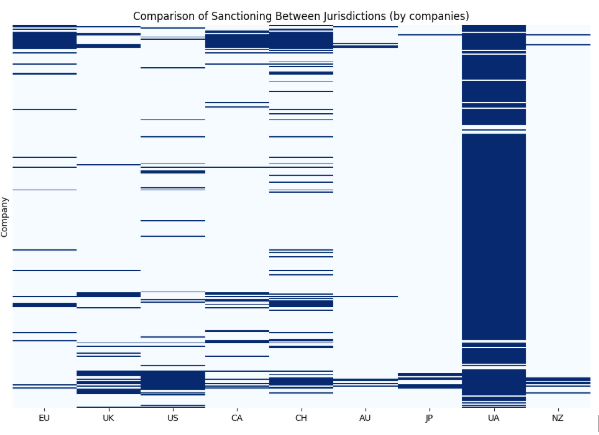
We compared Ukraine and its partners’ approach to sanctioning the companies from our data. The plot below demonstrates how each company from our data set of 338 entities was or was not sanctioned by the nine leading jurisdictions. The intense blue indicates that a company has been sanctioned, while the remaining light blue shows the lack of action.

Based on our data, Ukraine is an unquestionable leader in sanctioning the companies, which gives little surprise considering both the apparent prioritisation of the initial list of entities and the number of presidential decrees issued to impose restrictions against a wide range of different Russian companies since February 24, 2022.
The limitations of our analysis do not allow for making solid conclusions regarding the sanctioning picture as a whole. Yet, we can confidently state that the foreign response is rather weak within Ukraine’s recently prioritised pool of companies.

Currently, IzhBS needs one more jurisdiction to be sanctioned completely – the EU. However, the very process of sanctioning this company reveals how slow the jurisdictions are in targeting such middle-level entities. In March 2022, the US was the first to introduce sanctions against the company, with the UK joining two months later. The third country to support the restrictions was New Zealand (August 2022), while Ukraine was only fourth on the list (October 2022). Canada, Switzerland, Australia and Japan joined sanctions in 2023.
What about the people?
Targeting specific individuals involved in maintaining Russia’s capability to wage war against Ukraine is a challenging task as well. By the same entity-based logic, there are numerous ways of involvement in the Russian military-industrial complex. First and foremost, it pertains to government officials. Yet, it also includes shareholders and top management of numerous Russian companies (manufacturing or importing), the ones who support certain war efforts financially or resourcefully, whether they be Russians or foreigners. NAZK’s database has only some of them.
As shown in the plot below, the sanctioning of the above-mentioned individuals tends to be more compressed compared to a slightly less organised example of sanctions against the entities.

Yet, it also has its own inconsistent features. For example, Tactical Missiles Corporation JSC, a holding company for developing and producing bombs and missiles owned by the Federal Agency for State Property Management, has been fully sanctioned by all the key jurisdictions within 2022-2023. However, Boris Obnosov, the company’s Director General, remains only partly sanctioned: the EU, Switzerland and Japan are yet to impose restrictions against him. Even less sanctioned is Yan Novikov, head of fully sanctioned Almaz-Antey JSC, which specialises in anti-aircraft missile systems.
The targeting of the management from the middle levels of the Russian military-industrial complex is even less comprehensive, as Ukraine is typically the only country to impose restrictions against such individuals.
When it comes to foreigners, the targeting could be more consistent. A striking example of that would be Iran. Even though Iranian involvement in Russia’s war against Ukraine grows more extensive, the respective Iranian individuals are still not entirely under sanctions. For instance, several board members of Qods Aviation Industries, an Iranian state-owned aerospace company and a manufacturer of Mohajer UAVs, remain unsanctioned by the EU, Switzerland, Japan and New Zealand.
Albeit inconsistent, the overall targeting of individuals demonstrates a bit more proactive reaction: the US, UK, and Canada are the leaders in this area right after Ukraine. However, such coordination might be the direct result of not only this analysis’s limitations but also the very limited information regarding the individuals compared to the endless lists of companies.

The main trends in sanctioning the military-industrial complex of Russia
Sanctioning processes around the globe differ. The jurisdictions go through their procedures within their time frame. Respectively, our analysis shows how Ukraine and its partners approach sanctioning the selected companies and individuals through several features.
- There is no unified approach to targeting the Russian military industry. The very limitation of this analysis is an excellent example of the main challenge in targeting the Russian military-industrial complex. There needs to be comprehensive data on all the entities and individuals assisting Russian war efforts. Therefore, the jurisdictions chose between setting sectoral priorities, punctuate or reactive targeting.
- Sanctioning needs more speedy cross-country harmonisation. Whether it be Rostec or one of the companies under the management of its subsidiaries, such a potential subject of sanctions may not be sanctioned fully and relatively immediately by different jurisdictions. While it might be reasoned by the complications of local procedures, insufficient institutional capacity or lack of day-to-day monitoring, it still affects the efficacy of the restrictions, leaving too many entities and individuals only partly covered.
- Jurisdictions need to target the industry systemically. There are numerous imbalances in the time and place the restrictions were imposed and in the targeting: whether or not the entity has been sanctioned ‘in package’ with its management and shareholders. Such imbalance works for both high- and middle-level companies and affiliated individuals.
This publication was compiled with the support of the International Renaissance Foundation. It’s content is the exclusive responsibility of the authors and does not necessarily reflect the views of the International Renaissance Foundation.