

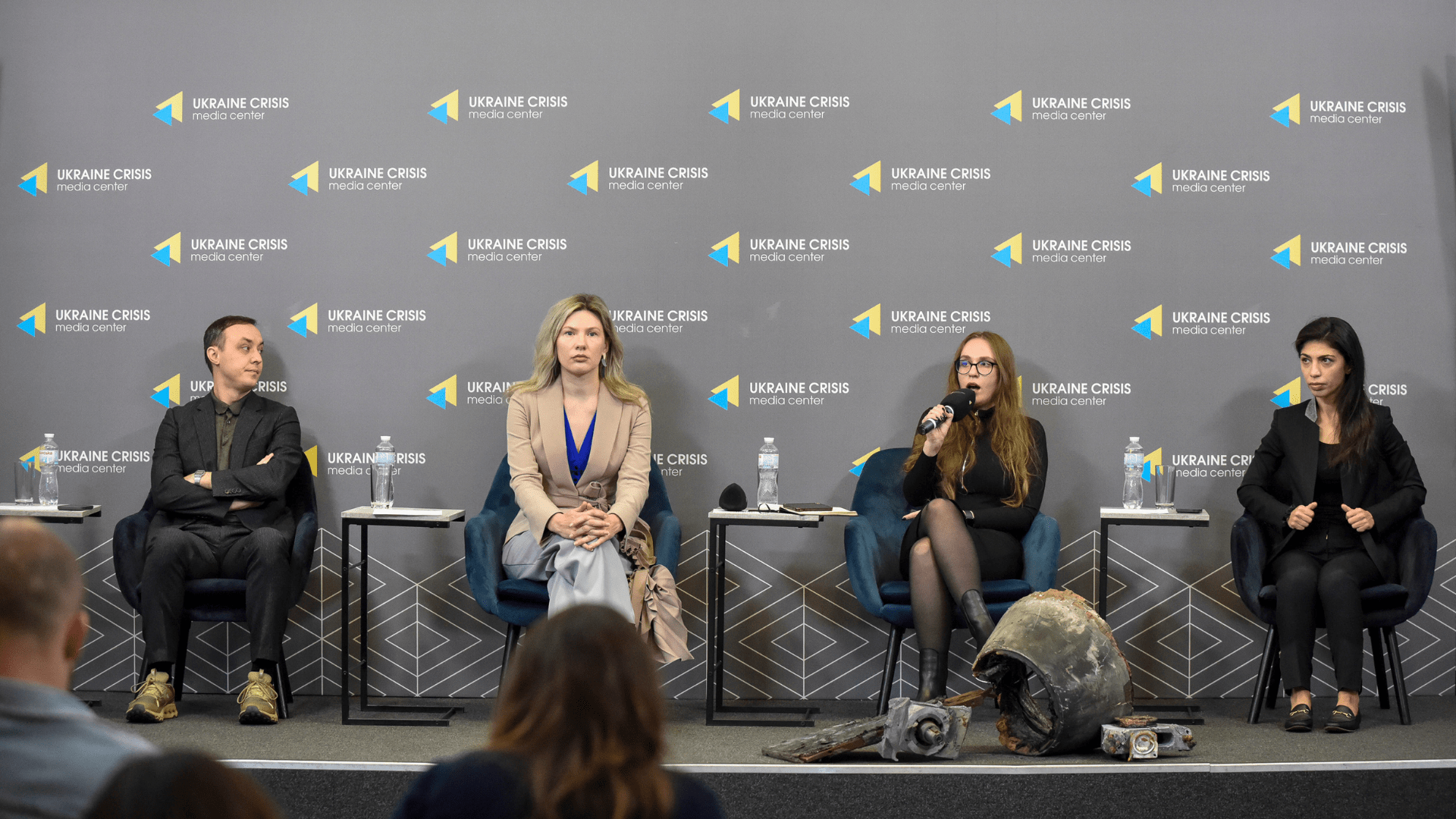
On 17 October, NAKO presented analytical material on foreign components in the North Korean KN-23/24 missile, also known as the ‘Quasi-Iskander’. NAKO experts examined the wreckage of a missile shot down over the Poltava region in September 2024.
Western microelectronics produced in 2021-2023 were found in the KN-23/24. Most of the components are labelled by American companies. In total, the experts were able to identify manufacturers from four countries — the United States, the Netherlands, Switzerland and the United Kingdom.

The North Korean missile contained electrical transformers, diodes, transistors, photosensitive semiconductor devices and, most importantly, electronic integrated circuits. ‘Absolutely all of the components fall under the export control regime imposed on Russia after its full-scale invasion against Ukraine. Similar, though not identical, restrictions were in place against DPRK long before that,’ said Viktoriia Vyshnivska, NAKO Senior Researcher.

For example, a 2021 chip was found in the Quasi-Iskander. It falls under the first level of export controls in the classification developed by the US, UK, Japan and the EU against Russia. In addition, this microchip is a strategically important component in terms of certain US export controls.
Russia, North Korea and Iran are not only exchanging weapons but also technologies. Their scientific and industrial cooperation is growing and could pose a threat to Western countries in the near future. ‘Russia has improved the accuracy and EW resistance of its own Iskanders, and I suspect that the same work is being done to improve the North Korean missiles available to the Russian army. There is also an exchange at the level of UAV programmes, something Russia has already done with Iran. This large configuration of strengthening military capabilities and technological means of destruction between terrorist regimes is a big problem for the entire democratic world,’ warned Vladyslav Vlasiuk, Presidential Commissioner for Sanctions Policy.

Is it possible to stop the flow of Western microelectronics to the ‘axis of evil’ countries?
According to Olena Tregub, NAKO executive director, today’s manufacturers of critical technologies bear no responsibility for the fact that their products end up in Russia. During two and a half years of full-scale war, the supply of Western technology to Russia has not decreased, and some companies have even increased their sales. Western countries should legislate requirements for companies to track end customers more closely.

‘Iran has been under sanctions for more than 30 years, but still managed to produce Shaheds, sometimes using engines stolen in the early 2000s. North Korea has been under sanctions for many years, but received chips in 2023 and most likely in 2024. So it is impossible to completely restrict the flow of microelectronics to authoritarian countries. We can only make these processes more difficult for them,’ said Vyshnivska.

Our partner countries should create a platform for coordination and information exchange at the intergovernmental level to synchronise sanctions policies. The role of business is equally important. ‘No government agency, no public project, no association will see supply chains the way manufacturers see them. They have AI systems, they can analyse big data. They have the ability to see where their machine tool, microchip and so on will end up,’ says Agiya Zagrebelska, Director of Partnership Development at the Economic Security Council of Ukraine. But big business is unlikely to respond unless there is a threat of punishment.


To read the analysis of Western components in the North Korean missile, please follow the link.
We are grateful to the Ukraine Crisis Media Center for its support in organising the presentation.