

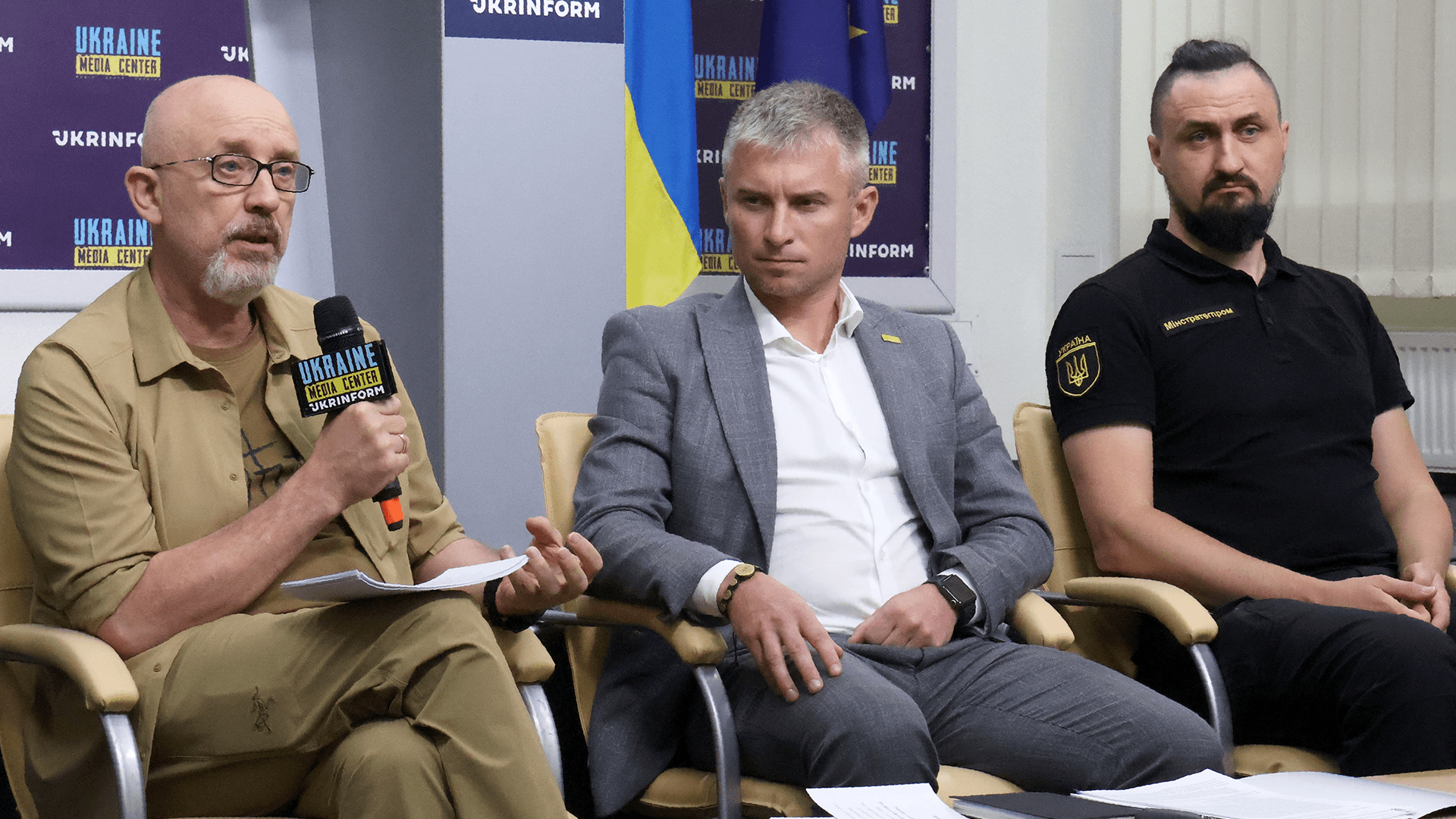
"How to implement anti-corruption policy in the security and defence sector during wartime?" Such a basic issue was discussed by representatives of authorities and the public during a press conference organized on July 18 by the National Agency on Corruption Prevention (NACP) and the Independent Anti-Corruption Commission (NAKO).
The heads of state bodies participated in the discussion: Oleksii Reznikov, minister of defence of Ukraine, Oleksandr Novikov, Chairman of the NACP; and Oleksandr Kamyshin, minister of Strategic Industries.
The civic was represented by Svitlana Musiiaka, head of research and policy making at NAKO, and Hlib Kanevskyi, an expert on anti-corruption policy and Head of NGO "StateWatch".
Combating corruption in the defence sector: the position of the State authorities
Chairman of the NACP Oleksandr Novikov assured that his department and institutions of the defence sector are strengthening work on building integrity and combating corruption. And the agency's role has grown: in addition to the priority direction of preventing corruption in the defence sector, it has begun to form an integrity policy by NATO standards. The President of Ukraine appointed the Deputy Chairman of the NACP, Yaroslav Lyubchenko, as the National Coordinator for Ukraine's cooperation with NATO in building integrity. "We are for integrity as a category that determines the effectiveness of any institution," Novikov emphasized.
According to him, a structural unit has started working in the agency, directly engaged in building integrity in the security and defence sector. He will cooperate with all security and defence agencies to build a compliance system and implement measures of the State Anti-Corruption Program for 2023-2025 (SAP). Such as the Ministry of defence of Ukraine, the Ministry of Strategic Industry, and the joint stock company "Ukrainian defence Industry."
"Cures" were prepared by all of you, colleagues, back in 2020, and last year the parliament approved the Anti-Corruption Strategy as a "cure" for corruption. On March 4, the government approved the State Anti-Corruption Program – a specific plan for taking these medicines," the head of the NACP said during the event.


"It's more like a treatment and prevention protocol. Each department has its plan of measures to make the body healthy. Moreover, any things that weaken us affect the defence capability of the country, which repels the enemy," Oleksiy Reznikov, minister of defence of Ukraine, noted.
He emphasized that the fight against corruption is also a matter of trust in Ukraine on the part of partners. And we "cannot fight back one hundred percent without their help." "When I was in November 2021 for the first time after being appointed as the Secretary of defence in the United States and asked for Stingers, the answer was "No, it's impossible." And then everything became possible. And this means that the level of trust in Ukraine has increased, and the level of trust in the defence forces has increased. We need to maintain that trust. And it is corruption that undermines this trust," Reznikov emphasized.
Reznikov assures that structural changes have taken place in the MoD- distribution of functions and powers to prevent corruption. In particular, it is about the reform of defence procurement. "We are on the way to transferring purchasing functions from the ministry's departments. They should deal with planning, standardization, etc., and the relevant agencies should deal with commercial matters. There is already an agency that deals with such purchases, and I think that within two months, an agency dealing with rear support will become operational. The political will is there; we are working on regulatory acts," he said.

The minister of defence of Ukraine emphasized that now it is important to set an example to others, doing what the legislation does not require but also does not prohibit. "We are not obliged to create an anti-corruption council under the minister of defence, but we created it, and soon it will be three months since it has been working. And it seems that this consultative and advisory body works well," the minister gave an example.
Similarly, current legislation does not oblige the Ministry of defence to purchase anything for the Armed Forces of Ukraine through the Prozorro system. It requires doing so on a competitive basis but in closed mode due to the legal regime of martial law. "But we analyzed the legislation and saw that in the direction of resource provision (food, clothing, etc.) we can enter more transparent and understandable competitive platforms even during martial law. And the Ministry of defence returned to Prozorro. And thanks to this system, another procurement of food services was carried out for a huge number of our Armed Forces servicemen. I believe this is a positive development, and we will now go as far as possible on all other types of purchases that do not involve the "Secret" regime, – he said.
Transparency, accountability and prevention of corruption risks meet NATO standards, but Ukraine needs them more than the Alliance because it affects the state's defence capabilities – says Reznikov.
Minister for Strategic Industries Oleksandr Kamishyn assured that his department is working on creating an effective anti-corruption infrastructure in the defence industry. In particular, on making defence procurement more transparent and on programs that will allow state property to be managed more efficiently.
Implementation of anti-corruption measures: public opinion
Experts presented during the press conference NAKO analytical brief "State anti-corruption program for 2023-2025: success factors for the defence sector". The document presents the results of the analysis of 35 main activities of the SAP.
According to experts, the success of their implementation depends on three factors: the use of an effective process management system at the level of ministries and departments, proactive monitoring of the effectiveness of implementation with the involvement of the public, and adjustment of the strategy for the implementation of measures by the level of sensitivity (i.e., the possibility of implementation during wartime, taking into account the requirements of information security).
In the brief, three levels of sensitivity of the measures are highlighted: high (system and data protection is required, involves a delay in the release of information), medium (test operation is possible), and low (does not pose a threat to security).
"We have to fulfill the priority tasks stipulated in the State Anti-corruption Program and Strategy, even in martial law conditions. Although these documents were developed before the start of a full-scale invasion, they have not lost their relevance. But we are aware that implementing certain measures must be adapted to current realities. We have analyzed to what extent it is possible and in what status to perform them during martial law. Among more than 60 measures of the anti-corruption program in the defence sector, we analyzed 35 key ones," she said. Svitlana Musiiaka, head of research and development of policies of NAKO.

According to her, in martial law conditions, some measures of SAP have a high level of sensitivity. This is, for example, the development of information systems or regulatory acts and the publication of large data sets. Therefore, providing full access to information only after victory is possible.
But it is important to look for new effective mechanisms of interaction with the public to ensure an optimal balance between transparency and secrecy. "In martial law conditions, it is still important to actively involve experts and the public to carry out independent public control over whether the measures are carried out properly," she emphasized.
Anti-corruption policy expert Kanevskii noted that the public understands the need to postpone some anti-corruption measures. If army vehicles delivering fuel are equipped with trackers, this will create additional risks in wartime conditions. "But before equipping cars with trackers, it is necessary to prepare legal acts and an automated monitoring system. And this preparation can be carried out now while the system can be put into operation after our victory," he said.
This also applies to the commissioning of the register of participants in the selection and executors of state contracts. This anti-corruption tool has long been provided for by the Law "On Defence Procurement". It will make it possible to reduce communications between business representatives and authorities that order weapons, ammunition, etc. "The anti-corruption program is a chance to implement this reform finally," Kanevskii said.
The expert noted that implementing SAP measures means reforming the country and bringing Ukraine's defence sector closer to the standards of NATO member states. In his opinion, it is necessary to carry out defence procurement reform and corporate reform of Ukroboronprom.
Sergii Stepanyan clarified that preparing relevant legal acts is quite realistic. At the same time, software development needs a clearer vision of time perspectives. "Our IT specialists say that such a product quickly becomes outdated; on average, it "lives" for three years, so this should be considered," he explained.
The Ministry of defence has developed a plan of measures to implement the SAP and will ensure its implementation, except for measures with security restrictions, Stepanyan assured. It is currently planned to create a working group, and the Ministry and the NACP will agree on the deadlines for implementing individual items of the anti-corruption strategy.

Head of the Department of Anti-corruption Policy of NACP Dmytro Kalmykov presented a system for monitoring the implementation of the state anti-corruption policy, thanks to which it is possible to monitor the status of implementation of SAP measures. He said that on August 17, the public part of the monitoring system will be opened to the public, and everyone will be able to see the progress of anti-corruption measures.
"This system will be a source of complete and objective information on the implementation of the program's activities, will reflect the results of quarterly monitoring and annual evaluation, and will contain a feedback tool for the public," said Dmytro Kalmykov.
Head of the Department of Integrity Policy Formation in the Security and defence Sector of NACP Marina Barynina spoke about the main areas of work of the newly created division. According to her, the administration will become a "center of excellence" in building integrity in security and defence. It will perform the functions of the "Single Window," which will ensure the coordination of the interaction of the NACP with the mentioned bodies, providing them with assistance in the implementation of the Anti-corruption Strategy and SAP measures. In addition, the unit will become the Office of the National Coordinator for Ukraine's cooperation with NATO in building integrity.
The event "How to implement anti-corruption policy in the defence sector during wartime?" was held with the support of the Special Defence Advisor of the United Kingdom of Great Britain and Northern Ireland (Office of United Kingdom Special Defence Advisor: Ukraine).