

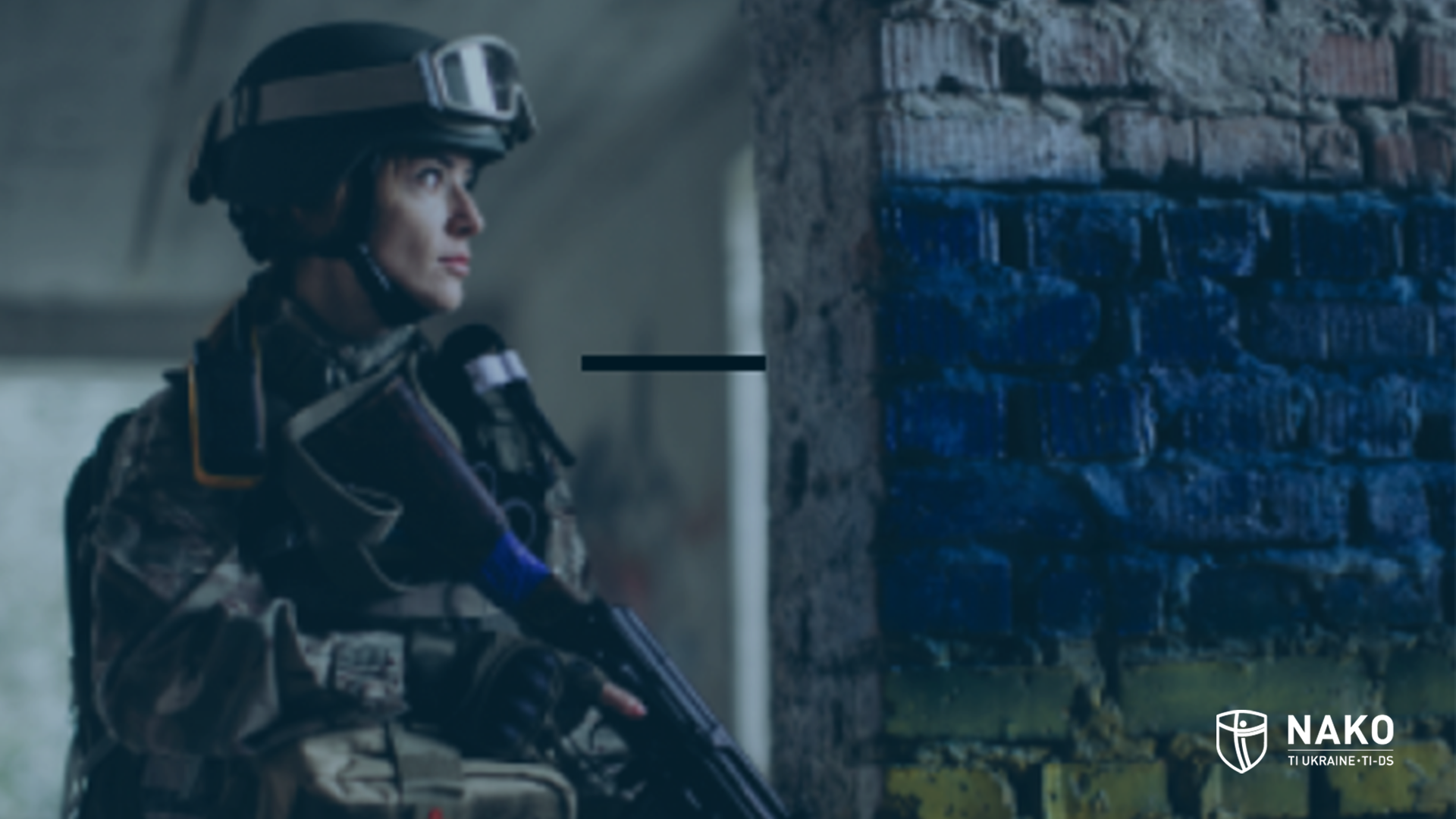
On July 7 NAKO together with its partners presented a cross-disciplinary study entitled Invisible Battalion 5.0 Cycle Monitoring of Recommendations and Research Results. The authors of the research considered the issues of the position of women and gender equality in the military, the position of female veterans in Ukrainian society, and solutions to the problem of sexual harassment in the Ukrainian army.
According to the data presented by the Ministry of Defense of Ukraine, 31,261 women served in the UAF only as of January 2023. In 2013, the figure reached 16,214. It means that in a decade, the number of women in the UAF doubled. At that, since the beginning of war, the number of female officers tripled to reach 5,112, while in 2013, only 1,633 women had an officer rank. There were 13,747 female sergeants as of January of this year, while in 2013, that figure totaled 4,784. From 9,797 in 2013, the number of female soldiers increased to 12,402.
“The number of women in the Ukrainian army increases, we see this trend. Gradually, more and more women access higher military ranks, thereby breaking the glass ceiling,” claimed Tamara Martseniuk, Candidate of Social Sciences, Associate Professor of the Department of Sociology of the National University of the Kyiv Mohyla Academy, during the research presentation.
The researcher states that women still struggle to obtain high positions and ranks in the military, yet this glass ceiling is gradually overcome. Over the last couple of years, women were awarded the ranks of generals for the first time. They include Medical Service Brigadier General Tetiana Ostashchenko, Medical Service Major General Liudmyla Shuhalei, and SSU Major General Yuliia Laputina. Hence, hopefully, the trend is here to stay.
The scholar also mentioned that almost all the military occupational specialties are accessible to women, which is a great step since 2015. This is in line with the international experience: the integration of women to the armed forces of other countries, for instance, the USA and some European states, was similar.
In her turn, Mariia Zviahintseva, Head of the Analytical and Advocacy Center Legal Hundred NGO, claimed that although women were no longer limited in obtaining the officer positions, in legislative terms, the situation left much to be desired.
“According to the regulation on the military service, women may be hired by military contracts in case there are job vacancies where servicewomen may fit. The higher military education establishments adopted practically the same provision for enrolling women to the officer positions. In February 2022, the Order No. 50 of the MoD was adopted, canceling the limitations for all of these officer positions,” she said.
“But there is a trick to it. This order makes all the officer positions accessible to women and actually amends the main order marked “for official use only.” It means that if the main order is amended for the official use, the list of positions may be cut. Potentially, it may have the implication that women can be awarded the positions which can be filled with servicewomen only, and the situation may be deteriorated,” the legal practitioner warned.
Ukrainian society supports the professional army accessible to women
At the same time, the research authors refer to the positive public opinion poll results manifesting that the majority of Ukrainians agree that women should be provided equal opportunities with men for working in the UAF and other military structures. “Combining the answers ‘I totally agree’ and ‘I rather agree,’ as of January of this year, it totals almost 80 % of the polled Ukrainian society,” Tamara Martseniuk claims.
In addition, Ukrainian society supports the concept of a professional army with equal access for women and men. Answering the question “What option of the army should be introduced in Ukraine?,” 66 % of the respondents opted for “Conscription of both women and men on a voluntary (contractual) basis.”
“The replies of the female and male respondents were not dramatically different. ‘Conscription of all men and some women’ – this is the option supported by far fewer respondents, although it came second (12.8 %). ‘Conscription of men only’ was supported by 12 % of participants. The so-called Israeli scenario which implies the conscription of all men and all women was and still remains unpopular,” Ms. Martseniuk shared the results of the poll.
Her colleague Anna Kvit, independent gender expert, alumnus of the Department of Sociology of the National University of the Kyiv Mohyla Academy, told about the representation of female defenders. According to the scholar, over the last years, the image of a servicewoman becomes more familiar and relatable: it is a new image which becomes ordinary in the Ukrainian society.
“From the point of view of articles and videos about women amid the war, the issues of women in the military and amid the war get a more analytical, even a more critical analysis. While in 2015, the content focused on the mere presence of women in the army, with some of them serving in the front line, in 2022 and 2023, some media write about women in the UAF and in the front line, refer to the issues of conditions of service for women, mention the career opportunities and limitations for women in the military,” she said.
The legislation needs to be changed towards gender equality
Mariia Zviahintseva, Head of the Analytical and Advocacy Center Legal Hundred NGO, told about the amendments to the Ukrainian laws. Specifically, a law extending the list of reasons for dismissal from the military service became effective. Apart from the pregnancy and maternity leave which were grounds for dismissal of women from the military service, now, any spouse from the couple of military servants may voluntarily quit.
“Men are entitled to paternity leaves. It is subject to the law on the vacations but does not cover the vacations of the military servants which are regulated by a separate legal act. Male military servant cannot go on a paternity leave as a vacation,” states the lawyer.
“The same goes to reimbursement of additional vacations. According to the law on the social and legal protection of military servants, additional vacations are, among other things, reimbursed for women with children, although according to the Code of Labor Laws, these additional vacations can be taken by any of the spouses, a father or a mother, if, for instance, the child is younger than 15 years old or has a disability. Hence, with this reimbursement limitation for even the additional vacations women are subject to, single fathers who are military servants bringing up such a child do not get into the list. This is life: a mother can be deprived of parental rights, she may die, and the rights of a man with a child are limited. Thus, among other things, the draft law No. 5713 offers to extend all the guarantees on the childhood and parenthood protection to women and men equally,” she stated.
The necessity of education and awareness-raising on gender-based violence
Tamara Martseniuk mentioned the issue of preventing the gender-based violence and sexual harassment. She claims that despite the availability of hotline and helpline of the Ministry of Defense and the General Staff of the UAF, as well as non-staff call centers of the UAF military control bodies, the female military servants have more trust in the NGOs, hence, refer to those more frequently.
The Associate Professor of the Department of Sociology of the National University of the Kyiv Mohyla Academy told that, specifically, 10 servicewomen called JurFem: Support hotline (project of the Ukrainian Women Lawyers Association JurFem) referring mostly to instances of sexual harassment and discrimination. NGO La Strada – Ukraine with its large-scale and well-known National Hotline for Prevention of Domestic Violence, Human Trafficking, and Gender Discriminations received 147 calls regarding sexual harassment and sexual violence. Among them, there were two cases of sexual violence during the military service: raping of a servicewoman during the military service and sexual harassment by the commander during the military service. Another woman reported sexual harassment against her to the Legal Hundred’s hotline.
JurFem: Support initiated four proceedings on sexual violence against servicewomen. It is paramount for us to win these cases. Successful judgements are what lacks in Ukraine in terms of labor harassment issues in the broad sense. As the defense sector becomes an increasingly more important labor market component, we should consider this issue even more closely. Not all the victims of sexual violence are ready to report the incidents, but we have a couple of cases. The wall of silence gets broken brick by brick,” Martseniuk mentioned.
She stressed the necessity of education and awareness-raising on gender-based violence. “We have developed an online course on the Prometheus platform entitled Gender Equality and Counteracting Sexual Harassment in the Military Sector. In almost two years, 20,000 people graduated from this course with certificates. This is a rather impressive figure for such a sensitive topic. Partially, the popularity of the course can be explained by the fact that the Department of Military Education and Science of the MoD recommended to include it to the curriculum of its higher military education establishments and military structural units of the educational establishments. It is very important to promote this type of education and similar courses to further prevent sexual violence and different forms of gender-based violence in the security and defense sector,” the researches stated.
Research methodology
Invisible Battalion 5.0 Cycle Monitoring of Recommendations and Research Results study was conducted from December 2022 until March 2023. The authors of the research:
- NAKO Head of Research and Policy Svitlana Musiiaka,
- Executive Director, Institute of Gender Programs NGO, Maryna Lazarenko,
- Candidate of Social Sciences, Associate Professor of the Department of Sociology of the National University of the Kyiv Mohyla Academy Tamara Martseniuk,
- independent gender expert, alumnus of the Department of Sociology of the National University of the Kyiv Mohyla Academy Anna Kvit,
- independent gender expert Hanna Hrytsenko,
- Head of the Analytical and Advocacy Center Legal Hundred NGO Mariia Zviahintseva,
- lawyer-analysts of the Legal Hundred NGO Viktoriia-Nataliia Fatsiievych, and
- lawyer-analysts of the Legal Hundred NGO, Alla Bieloshenko.
Their profiles are available here.
According to the Executive Director of Institute of Gender Programs NGO, Maryna Lazarenko, the research consists of two parts: academic and field (empirical). The academic part is cross-disciplinary and unites the legal and the social components. The legal component encompassed the analysis of the legal framework and the status of recommendations developed by the previous research of the Invisible Battalion cycle. The sociological part referred, first of all, to the secondary analysis of the statistical information from the open sources and the results of queries to the Ministry of Defense of Ukraine, Ministry for Veterans Affairs, such NGOs as the Legal Hundred, Ukrainian Women Lawyers Association, and La Strada – Ukraine. The empirical part implied the use of both quantitative and qualitative sociological methods. Specifically, it was important to obtain the public opinion on gender inequality in the UAF in dynamics.
“Within one of our previous studies entitled Invisible Battalion 2.0, in 2018, we cooperated with the Kyiv International Institute of Sociology to collect some information, and now, after almost five years, we decided to ask the same questions again. This time, we engaged Info Sapiens research agency for cooperation. We conducted a poll engaging 17 experts on the integration of women in the security and defense sector and maintaining gender equality in the UAF. Specifically, they included representatives of public authorities, civic activists, and the media,” she added.
“Each of the stages of the project is dedicated to a specific topic, and all advocacy campaigns of these parts always began with a research. This study is a kind of conclusion. On the other hand, it is also a starting point for assessment of the directions demanding urgent attention,” she added.
NAKO Head of Research and Policy Svitlana Musiiaka mentioned that NAKO added gender issues to its research portfolio two years ago. However, the organization became interested in this direction since its very establishment in 2016. Several successful projects were implemented.
“They included the methodology of gender audit of security and defense budget programs and a study of career paths of women using the example of the Ground Forces ‘which was not published for security reasons.’ In addition, we have recently presented a sociological study conducted together with the Ukrainian Veterans Foundation and Rating Sociological Group. In it, we analyzed the instances and attitude of the population to the discriminated and vulnerable groups in the UAF,” she said.
Ms. Musiiaka thanked the Legal Hundred, the Invisible Battalion, the Institute for Gender Programs NGO, as well as experts and researchers “who participated in the development and implementation of the new, important analytical tool.”
“We continue our advocacy efforts and implement communication campaigns together with influential research partners. We strive for Ukraine to reach stable progress in implementing gender equality in the UAF,” said Ms. Musiiaka.
Invisible Battalion 5.0 Cycle Monitoring of Recommendations and Research Results was implemented within the NAKO project entitled Promotion of Gender Equality in the Ukrainian Armed Forces supported by Office of United Kingdom Special Defence Advisor: Ukraine.