

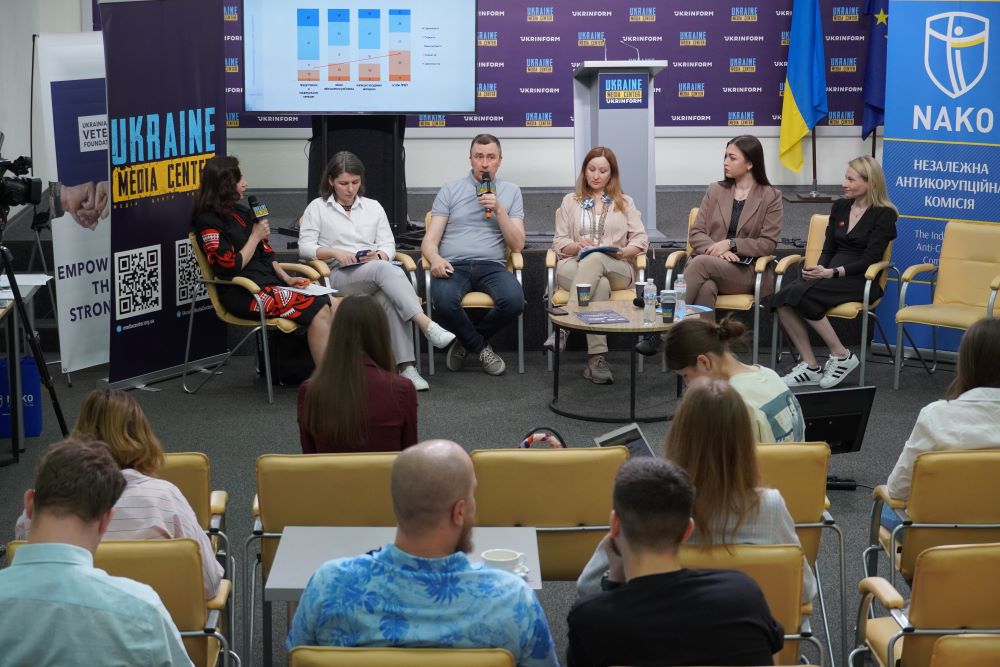
The study “Discrimination of different social groups in the Armed Forces: views of military personnel and civilians” was presented by the Ukrainian Veterans' Fund of the Ministry of Veterans and the Independent Anti-Corruption Commission – NAKO. The research is based on the data of a survey conducted by the sociological group "Rating" on behalf of the NAKO and the Ukrainian Armed Forces. "Solving a problem begins with acknowledging the problem. The problem of discrimination exists. We singled out the following groups: women, representatives of the LGBT community, and national minorities, and we also added the category of former prisoners. Many more groups can be discriminated against.
There is still a lot of work to be done here", she said during the presentationSvetlana Musiiaka, Head of Research and Policy Development of NAKO. Equality and non-discrimination in the Armed Forces of Ukraine are improving, especially since the beginning of the full-scale Russian invasion of Ukraine. However, the researchers state this improvement is not uniform in relation to different social groups. On March 27-29, 2023, 2,000 people from all regions took part in the survey, except for the temporarily occupied territories of Crimea and Donbas and territories where there was no Ukrainian mobile communication at the time of the survey. "We conducted a survey of citizens on attitudes to discrimination. And then, they talked with male military personnel and women who serve. Separate category– services from the LGBT community. During the research, we discovered problems that will continue to exist in society", said Lubomyr Mysiv, deputy director of the "Rating" sociological group.

"The perception of some categories separately from the army and those in the Armed Forces is different in society. Let's say that the attitude towards LGBT people is changing, but not so quickly. The situation is better in the Armed Forces. There, the attitude is positive, regardless of gender or orientation", the researcher noted. Assumes: stereotypes are not eradicated quickly, although the war will accelerate this process. "For military personnel from the rank and file, everyone nearby–yours. But much of the attitude toward women or LGBT representatives depends on the Commander's attitude. Commanders establish communication in the unit and form principles of behavior. Commanders become people of a certain type, and working with those who understand them is easier. This requires work, particularly with psychologists", believes Lubomyr Mysiv.
As the study proved, the attitude of the Commander and the command towards women or representatives of the LGBT community plays a significant role: if the Commander is impartial, the unit's attitude is also normal. Women in the Armed Forces have become increasingly visible since 2014. A woman must prove she can be a soldier and take on more. Privates usually perceive women: they know that they can perform tasks and be commanders – explains Mysiv. Doctors show endurance. And men say they could not withstand such a psychological burden. "But we often understand discrimination as oppression.


Meanwhile, it can also be discrimination due to positive motives– when they are not allowed to do something, thinking it will be difficult for a woman. Young girls understand sexism; older girls do not", he noted. According to Oksana Grigoryeva, adviser on gender issues to the Commander of the Ground Forces of the Armed Forces of Ukraine, stereotypes and discrimination are not a problem of the army itself but of society in general. But it notes positive societal developments and broader opportunities for women in the Armed Forces.
"The major shift took place in 2018, when women were allowed to hold any combat positions in the Armed Forces of the sergeant and officer ranks. There were problems with this before. You cannot be awarded as a female sniper because, formally, you are– a cook. You have a different salary and benefits. After 2018, the situation changed. She reminded us that women either went to study or to the positions they chose themselves". "At the same time, women were allowed to study in all military specialties. Before that, they did not have such a right. Why do we have only two female generals and a few women in leading military positions? Because there was no opportunity to study. Now there is a graduation of women with appropriate military training. Because without a military rank, without graduating from the department, you will not become a commander. Over time, we will see growth; there will be more women in leadership positions", believes Oksana Grigoryeva. According to her data, there are now about 62,000 women in the Armed Forces. There are more than 16 thousand in the ground forces. Approximately 5,500 women are on the front lines. "In NATO countries, women are no different from men. There, attention is paid to physical training. There, the attitude of society is different. There is a set of standards for everyone, and no one divides by gender. Fortunately, we have changes in society. The main criterion should be professionalism, not gender or orientation", Grigoryeva emphasized.
Regarding the attitude of the army towards national minorities, according to the data from Lubomyr Mysiv, then there people of any nationality are perceived as brothers. "Civilians have a negative attitude towards Belarusians and Russians, but the army does not. At the same time, a commander of another nationality is not perceived positively. This stereotype exists both among the civilian population and in units", he says. There are facts of discrimination at the front and in communities, at work to which veterans return, she noted Svetlana Berezina, director of the strategic planning directorate of the Ministry of Veterans Affairs. According to her, the ministry conducts training for business enterprises to teach civilians how to receive fellow veterans. To avoid including discrimination. "Veteran policy is actively implemented. One of the priority projects is the Veteran's Assistant Institute project. Someone needs help from the platform; when a person returns home, they return to the community independently. Already in June, we plan to start the selection of candidates for assistants. The pilot project will be implemented in Vinnytsia, Dnipropetrovsk, Mykolaiv, and Lviv regions.
We actively use digital tools for selection. We will conduct interviews with such assistants to avoid discrimination. And the research results will be needed at every stage of accompanying the assistants of veterans and their family members", she said. "We should pay attention to what the veterans are saying. And now to conduct audits in our state services. Otherwise, we will soon have problems with the moral and psychological state of these people", Ruslana Velichko-Trifonyuk, the first deputy Executive Director of the Ukrainian Veterans Fund of the Ministry of Veterans Affairs noted.
She drew attention to the problem of discrimination against widows of fallen soldiers. Mostly, they live in small villages in a patriarchal environment, which causes certain difficulties. "Even according to the law, the wife of a soldier who died, who survived all this and remarried, will no longer have status. Perhaps we should consider the option that she will not have any benefits, but the status will remain. We cannot erase from a person's memory what he experienced", she said.
Velichko-Trifonyuk also drew attention to the fact that today there is already inequality between family members of veterans who died from 2014 to 2022 and those who died after.
It is not necessary to divide society; it should be combined. And this should be taken into account in the relevant legislative changes. Artem Denisov, head of the Veteran Hub organization, raised the issue of discrimination against people who were injured or disabled and continue to serve. "They are removed from the unit staff as if they cannot participate in combat operations, although they can. Some people had previous combat experience, could not officially be fit, but passed the commission in pants – so that it would not be noticed that they do not have a lower limb and get the expected "fit." There are many such people.

In the subdivisions, separate subdivisions are being created where people with injuries and disabilities are taken. He noted that this is also discrimination, and in the public sphere, it is still not heard much". "People who were injured were removed from the staff of the unit– they no longer take part in hostilities, they no longer receive a corresponding salary, and at the same time, they have not yet come under the protection of the Ministry of Social Policy or the Ministry of Veterans. This is an extremely important issue that needs to be addressed. After all, these people gave their health for Ukraine, protecting it", she added Oksana Grigoryeva, adviser on gender issues, to the Commander of the Ground Forces of the Armed Forces of Ukraine. "Many soldiers are injured. And also – a large number of invisible consequences of war. Most Ukrainians also felt the war, even in relatively peaceful cities. When we talk about policies for veterans, we also need to talk about policies for civilians", Yulia Kirillova, a veteran analyst of the UVF, noted.
"Society is changing, and veterans come back and don't understand what's happening. We have to formulate problems and prepare alternative options for solving these problems. I think that such studies are necessary for this", she emphasized. "We still have much to learn about ourselves and those around us to solve these problems. Something– at the level of legislation, something– due to training, joint events, something– needs attention. One more time, you must say: "I respect you. You may not be like me, but I respect you", Svitlana Musiiaka, Head of Research and Policy Development of NAKO, noted. Therefore, communication campaigns to draw attention to the problem are especially important. Such as, the communication campaign "Veterans are different, victory is one" was recently held by the UVF and NAKO. After all, to destroy stereotypes, we must actively work with society.
The study and the event was held with the support of the UK Special Adviser on Defence.