

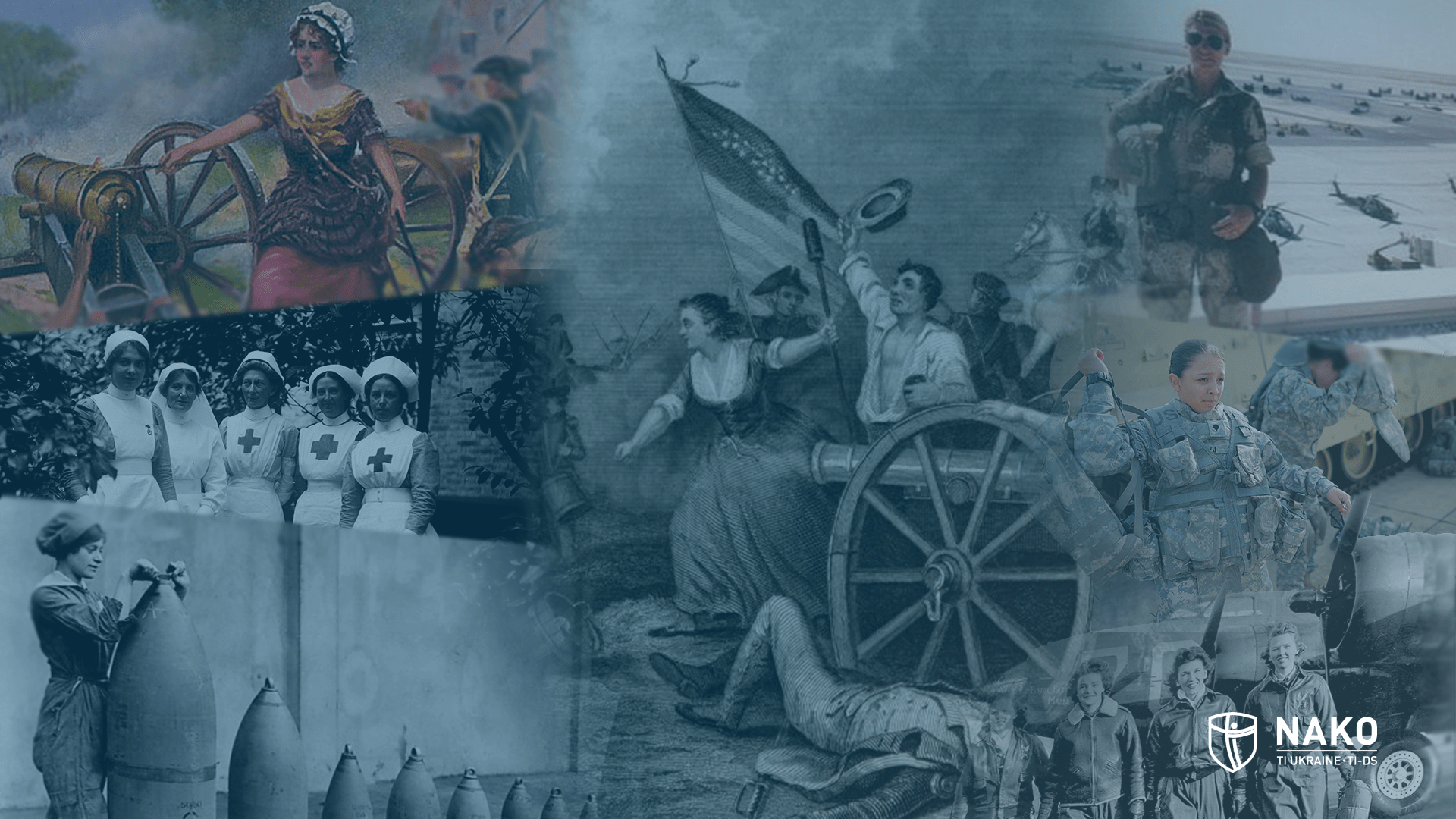
We have already discussed the ways Ukrainian society has changed its opinion on women serving in the army. However, this issue has been and remains relevant not only in Ukraine. Women in the US Army have come a long way over the past three hundred years. They had to disguise themselves as men to fight; they were accused of nepotism and providing sexual services in exchange for ranks; women had limited access to military education and were called “freaks.”
Despite this, 27% of the modern US Army are women. So, how did women fight for their place in the army? What challenges and prejudices did they overcome? And what lessons can Ukraine learn from them?
The invisible soldiers of the visible army
Women have been part of the US Army since the American Revolution. They were officially listed as cooks, laundry girls, and nurses during the Revolutionary War. But at the same time, many of them secretly fought along with their husbands. In some cases, women disguised themselves as men or even changed their names. So, they could fulfill other duties – spy or smuggle.
However, the common women's area in the army was still medicine. Thus, in 1901, the Nurse Corps was created. However, even though the Corps was part of the US permanent forces, nurses were never awarded any officer rank.
In 1917, women were officially allowed to join the army. And nearly 33,000 women became military nurses, chaplains, and other personnel.
And already during WWII, their number increased to 400,000, of these, almost 60,000 were nurses, and more than 1,000 women joined the ranks of the US Air Force. In July 1943, an important event took place – the Women's Army Auxiliary Corps was renamed the Women's Army Corps and became an official unit of the US Army. It allowed women to serve overseas, get benefits and allowances in case of casualties or death, and even get paid on equal terms with men in the regular army.

Nancy Harkness Love at the controls of a Fairchild PT-19.
Photo: US National Archives
WWII was rich in exciting stories proving that women did not just “lie low at the home front”. One of them was US Navy nurse Jane Kendeigh, who, at 22, became the first US Navy flight nurse to take part in a combat evacuation mission and the first to land on a battlefield in the Pacific. She saved more than a million patients during the war, transporting them along dangerous routes.
However, despite these stories, women's contributions to military history were often stigmatized and mocked, while women were sexually harassed. There were allegations that the women provided sexual services in exchange for their military positions or ranks. There were also widespread rumors that the Women's Army Corps program was a Nazi secret scheme to destroy the US Army. And some men were simply indignant at the fact that they had to serve together with women.
Post-war times or how women fought their way into the army
When the war ended, a new peacetime standard appeared: only female nurses could serve. It was expected that hundreds of thousands of women who served their country during WWII were to leave the army and return to civilian life.
As a result, many women became unemployed. Most employers were prejudiced against ex-military women, claiming they served due to sexual services or nepotism. Potential employers also believed such women were an alleged threat, wishing to undermine gender standards established in the workplace. But in fact, all this happened due to unwillingness to pay a salary on equal terms with men.
And then, in 1948, everything changed. Public dissatisfaction, along with examples of the women's performance who served during WWII, made society rethink the role and place of women in the US Army. Harry Truman then signed the Women's Armed Services Integration Act, which legally allowed women to serve in the US Army in a number of official positions.

Harry Truman signed the Women's Armed Services Integration Act Photo: US National Archives
This law was the first step to equality in the US Armed Forces. It was also important from the perspective of racial discrimination, as it allowed African-American women to serve. Thus, Annie Graham became the first black woman to join the Marine Corps in 1949.
Since then, women have been allowed to serve their country permanently and in peacetime. However, there were catches. The number of women in each military branch could not exceed 2%. Women who became pregnant could be involuntarily discharged from military service. But most importantly, the percentage of women who could become officers was limited. This was based on biological differences and stereotypes. At the same time, there was a desire to keep the military environment only for men.
Mary Hallaren, who began her career in the Women's Army Corps and later became a US Army colonel, recalled:
“The main reason, as we were told, was discussed in closed meetings, was as follows: if women were on equal footing with the male military, then the latter would have to follow women's orders. Heaven forbid.”
Later, since 1962, American female soldiers were sent to military training in the Vietnamese army. Then, 9,000 nurses served in hospitals across Vietnam, and 800 women from the US Army fought on the battlefield.
Gradually, women's roles expanded. In 1970, women were finally allowed to be promoted to command positions in non-combat units. The same year, for the first time, two women, Anna May Hayes and Elizabeth Hoisington, were appointed Brigadier Generals by order of Richard Nixon. A year later, women were granted the right to request maternity leave.
With the advent of the volunteer military system, the number of women increased several-fold: in 1972, it was 12,260 and in 1978 – 52,900. This allowed women to get military education in US higher educational institutions.
In 1975, President Ford signed a law allowing women to enroll in all-male military colleges. And in 1976, 119 women made history by becoming the first ones to join the Cadet Corps of the US Military Academy at West Point. In 1980, sixty-two of them graduated as second lieutenants in the Army.
Of course, this caused a furious reaction in society, and there were a lot of questions and disputes about the relevance of women's service.
The first year of women at West Point Academy Photo: National Museum of the United States Army

On the one hand, there were men like General William Westmoreland. To him, any woman who could succeed at West Point was “a freak, and I don't want to be head of a military academy for freaks”. On the other hand, there were numerous politicians, military commanders, and West Point graduates who believed women could succeed in the academy.
Since President Ford's declaration went into effect immediately, West Point had little time to create equal opportunities for men and women; therefore, the latter had to face such things as urinals in women's bathrooms or plastic zippers on pants instead of iron ones (as on men's).
However, this did not affect female cadets' studies. According to the research held by the Virginia Military Institute, women studied 5% better than men. Ironically, a success factor was women's “excess of emotions, " which allowed solving problems quickly.
Present days: new challenges and victories
In 1990-1991, about 40,000 American servicewomen were deployed during the Persian Gulf War to participate in Desert Shield and Desert Storm operations. Women had the same duties as men during the operations except for land battles. They could be shot at – it's just that according to the rules, then in force, they were not allowed to shoot back.
The terrorist attacks of September 11, 2001, marked a milestone for women in the army. As the military changed on the battlefields of Iraq and Afghanistan, so did the role of women in its ranks. Due to the Global War on Terrorism campaign, the number of jobs has increased rapidly, and women's role has changed.
Leigh Ann Hester Photo: Wikipedia

Another milestone occurred on June 16, 2005, when Sergeant Leigh Ann Hester was awarded the Silver Star for actions during a firefight outside Baghdad. It was the first Silver Star in US military history awarded to a woman.
In 2013, the US Secretary of Defense, Leon Panetta, signed a document canceling the ban on women participating in combat operations. This historic decision allowed women to participate in battles using artillery and armored vehicles, in the infantry, and other combat positions. And since 2016, all military professions and positions, without exception, have become available to American women.
But despite all these gains, the US Army still has its problems. Foremost, it is about sexual violence.
As of 2019, 23% of women reported sexual violence, and 55% reported some form of sexual harassment in the army.
Studies also prove that despite integration programs introduced by the government, the gender gap persists. And along with that, there is still a culture of toxic masculinity and stereotypes. Constant insults, talking of sex, and dirty jokes not only interfere with the effective performance of one's duties but also directly make such attitudes toward women acceptable. As a result, this creates a favorable environment for sexual violence.
What are the lessons in there for Ukraine?
Nowadays, women make up 27.4% of the US Army. However, this would have been difficult to imagine a hundred years ago: women could be anyone but not an official army member. History proves that wars and security threats catalyzed rethinking women's role and involvement in the Armed Forces.
The Revolutionary War showed that women tend not to stand aside. WWI proved that women deserve their place in the army. WWII proved that this place is not limited to service functions. The post-war years, although not very willingly, only consolidated these lessons and allowed to involve women in military operations more. And with the war against terrorism start, women in the army became not a whim but a necessity.
Ten years ago, women were not yet accepted in the Armed Forces of Ukraine. The war changed this: in 2021, 16% of the Ukrainian army were women. And in 2022, this figure was 22%, and 2% were on the front line. Still, the USA had a lot of time to gradually integrate women into the army, while Ukraine, unfortunately, did not have such a luxury.
Women's problems in the army are the same everywhere, but each country solves (or doesn't) them in its way. The Ukrainian military is forced to develop rapidly due to the war challenges. Ukrainian women have proven they are comprehensive members of this army and deserve the appropriate attitude.
Kashuk Anna,
NAKO Communications Officer